This post may contain affiliate links & I will earn a small commission if you purchase through them.
The Hydra Pen H6 is one of the most unique Dr. Pen innovations, and after using it, it’s quickly become my favorite device they’ve made. I was skeptical, but the results really won me over. I had unexpected improvements from just one treatment, which is not something I can normally say about microneedling. It generally takes quite a long time – and several treatments before you see any results at all. So when something stands out after a single session, that’s very unusual.
In this post I’m sharing my first two videos on the Dr. Pen Hydra Pen H6 – an honest first-impressions demo, and a results update I filmed about a month later. I plan to do more videos as I continue using it. I’ll walk through the device features, what the experience was actually like, and what I noticed afterwards.
What Makes the Hydra Pen H6 Different
The biggest thing that sets the Hydra Pen H6 apart from other Dr. Pen devices is the cartridge system. Each cartridge has a small tube built into it that holds your serum. When you do the treatment, the serum gets dispensed directly onto your skin through the needle tip as you go. You can control how much serum is released with different settings on the device.
This sounds like a small thing until you’ve actually done a microneedling treatment the traditional way. Normally you’re applying serum to your face, getting it on your hands, cleaning your hands, re-applying, trying to keep everything clean and sanitary. It’s a process and it’s important to keep things extremely clean. Normally when I do a treatment, I wear gloves and I have a small spray bottle containing alcohol. If I touch surface or my face, I’ll spray the gloves with the alcohol and then proceed. It’s so much easier to do the treatment when you don’t need to apply the serum like that. With the H6, the serum is dispersed onto your skin while you’re doing the treatment, making it a much more sanitary process.
Beyond the cartridge system, the H6 also includes:
✦ Built-in red and blue light therapy
✦ LED display
✦ Folding stand
✦ Wireless battery
✦ Six speed levels
✦ Adjustable needle depth and serum output
The device is currently between $280 and $299 and is available through MTP Skin Tech, which is the authorized Dr. Pen reseller I personally purchase from. You can use code LIFEDIY for 8% off sitewide.


My First Treatment – What Actually Happened
I went into the first session without numbing cream. I’ve done a lot of treatments over the years without it, so I figured I’d be fine. I was wrong – at least this time. I barely touched the pen to my skin at 0.5mm and the pain was significant enough that I stopped and reconsidered.
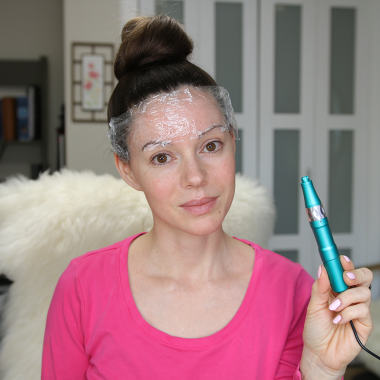
I’ve tried numbing creams before and had one that just didn’t work at all, so I was skeptical. But I decided to try the Curist numbing cream, which is a 5% lidocaine cream, and I was completely shocked by how well it worked. I had it on for barely 10 minutes and it numbed my face very effectively. After applying the cream, I covered the areas with small pieces of plastic wrap. I then removed that after 10 minutes and washed my skin very thoroughly.
Warning – numbing cream gets into your bloodstream, and if you’re sensitive to it, you may feel a little shaky or off. That happened to me. I drank a lot of water and took NAC afterward to help clear it out, and I was fine within a couple of hours. My face also had an unusual splotchy red reaction that I’m pretty confident was from the numbing cream rather than the microneedling itself.
A couple of things I learned about the serum cartridge during the treatment that are worth knowing:
The orientation of the pen matters. When I held it with the serum tube on top, the serum dispensed properly through the needle cartridge. Once I figured that out, it worked really smoothly.
For this session, I used sterile saline solution in the cartridge rather than my usual hyaluronic acid serum. I’ve been thinking more carefully about what I inject deeper into my skin during microneedling, and saline felt like the cleanest, safest choice. I read about it online, as some doctors preferred using that over anything else. I personally believe the biggest factor in improving your skin with microneedling has to do with the micro-injuries, not the serums you use. But, using this instead of a serum gave me some unexpected results.
💉 Needle Depth I Used
On the face generally: 0.5mm
On areas with visible lines or wrinkles: 1mm to 1.5mm
One Month Later – The Unexpected Results
About 35 days after the treatment, I filmed a follow-up video because I noticed something I genuinely wasn’t expecting. A line around my mouth that had been there for at least 5 to 8 years – something I had documented in old photos without even realizing it – had visibly improved. It’s still there, but I’d estimate that it had around a 20 to 25% improvement. And that’s not swelling or temporary plumping. That settled weeks after doing the treatment. I’ve done many microneedling treatments over the years, and I’ve never seen a change like that happen so quickly from a single session.
My initial theory: I thought that the numbing cream allowed me to do a more thorough, consistent treatment than usual. When you’re in pain, you naturally rush through certain areas or don’t treat the area evenly. Being numb meant I was more methodical and even. So at the time I filmed the update video, that’s what I believed, and I still think it played a role.
Updated thoughts on it: After posting the video, I received a really helpful comment from @synthethrvl asking whether the Hydra Pen’s serum delivery system could have contributed to the results. After thinking about it more, I think that’s a very real possibility – and honestly, it might be the bigger factor. I ended up doing more research on the topic, and also consulted claude ai.
Here’s why: I’ve treated this same area multiple times over the years at similar depths, and I never saw any change at all on this stubborn line. Because the Hydra Pen dispenses liquid directly into the skin while needling, it may be doing more than just creating controlled injury. It could be functioning more like microneedling combined with mesotherapy – delivering hydration into the skin during the wound-healing phase, which may change how the skin responds and recovers compared to dry microneedling. I’m not deeply familiar with mesotherapy, so I want to do more research before saying anything definitive. But it’s something worth considering if you’re looking at this device.
Future treatments: I’m really happy with what I’ve seen so far. Because collagen synthesis takes time, I won’t be treating that area again for at least four months – I don’t want to disrupt the process or create unnecessary inflammation.
What Microneedling Can and Can’t Realistically Do
There’s no treatment that works the same for everyone. Collagen synthesis takes time, and for most people it takes several treatments over months before you see significant change. I started noticing small differences from my first or second treatment in my original 16-month experiment, but I don’t want anyone expecting dramatic results after one session. What happened with my recent treatment was unusual. In general, microneedling can help with: fine lines, skin texture, pore appearance, skin tone, some scarring, and potentially deeper wrinkles if treated consistently and at an appropriate depth.
Results vary by person and by area. Microneedling got rid of certain lines on my forehead completely during my first experiment. It helped my overall skin tone and texture significantly. But some lines – particularly deeper ones around the eyes – aren’t currently responding too strongly to microneedling. For that area, I know that if I do a series of chemical peels I will have noticeable results and improvements. If the lower strength peels don’t work well enough, then I know that TCA peels would. These types of peels can be highly effective, but carry more risk and require caution. So please be careful and do your own research if you’re considering that route. I have numerous videos sharing my past experiences and before and after results from TCA and other peels.
Is the Hydra Pen H6 Worth It?
For anyone who already microneedles regularly at home, the H6 is a genuinely interesting upgrade. The serum delivery system makes treatments cleaner and more streamlined, and the built-in light therapy is a nice bonus. At $299 it’s not cheap, but it’s still far less than a single professional treatment at a clinic.
Whether the device itself contributed to my unexpected results, or whether it was my improved technique and the numbing cream that made the difference, I can’t say yet with certainty. I’m planning more treatments and will continue documenting what I see. If you’re curious, you can check out all my past skincare before and after results here.
As always – if you decide to microneedle at home, do your own research, be sanitary, be careful with depth, and know that whatever you do is at your own risk. This is what works for me, and I share it purely for informational purposes.

Where I Buy My Microneedling Supplies
If you’re looking for authentic microneedling pens and cartridges, I now buy my supplies from MTP Skin Tech – you can use code code LIFEDIY for 8% off your order. They are a licensed reseller for Ekai, which is the official manufacturer of Dr. Pens and cartridges. I’ve purchased from Temu in the past too when options were limited, and if you prefer to buy there you can use my code “acn120083” for 30% off, but there is less quality-control and no way of knowing if the products are authentic. The other products I mentioned include: Curist Numbing Cream (5% Lidocaine), Timeless Hyaluronic Acid Serum, and Cos De Baha Hyaluronic Acid Serum.