📌 Quick Overview
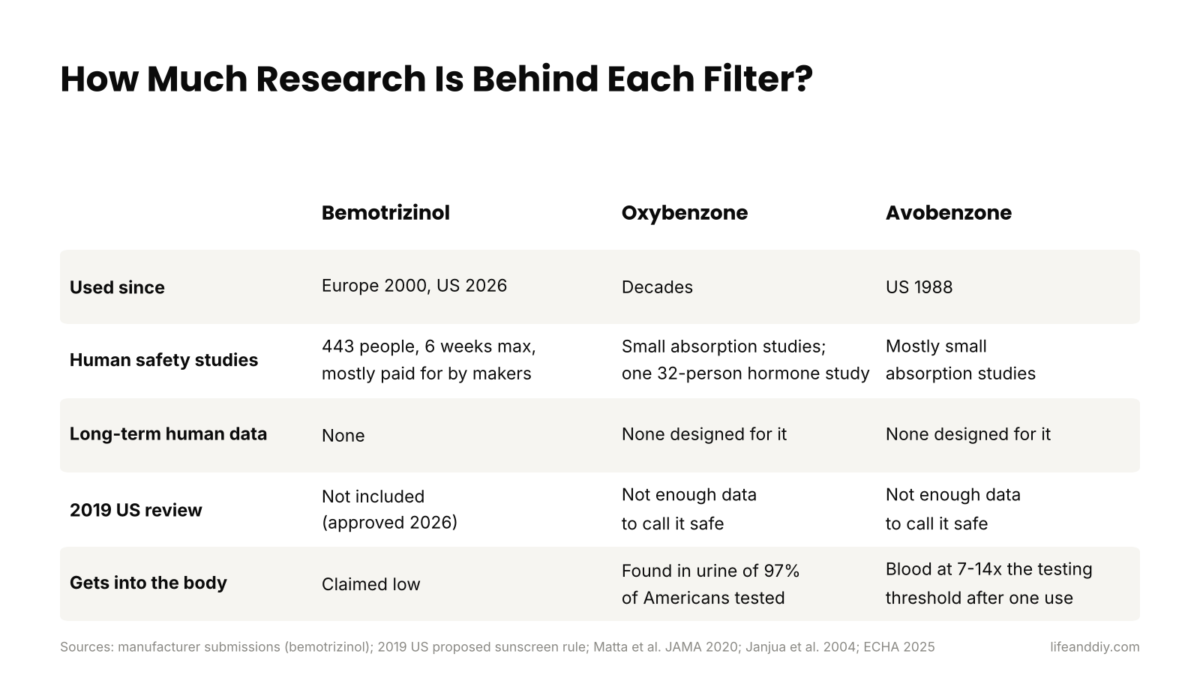
Bemotrizinol is a chemical sunscreen filter that’s been used in Europe since 2000 and became legal in US sunscreens in August 2026. Its safety research in people adds up to 443 participants across five small studies, the longest lasting 6 weeks, and nearly all of it was paid for by the companies that make it. Based on that research, it’s said to barely get into the bloodstream, unlike older chemical filters like oxybenzone. But, it doesn’t protect you any better than your mineral sunscreen with zinc oxide.
What Is Bemotrizinol?
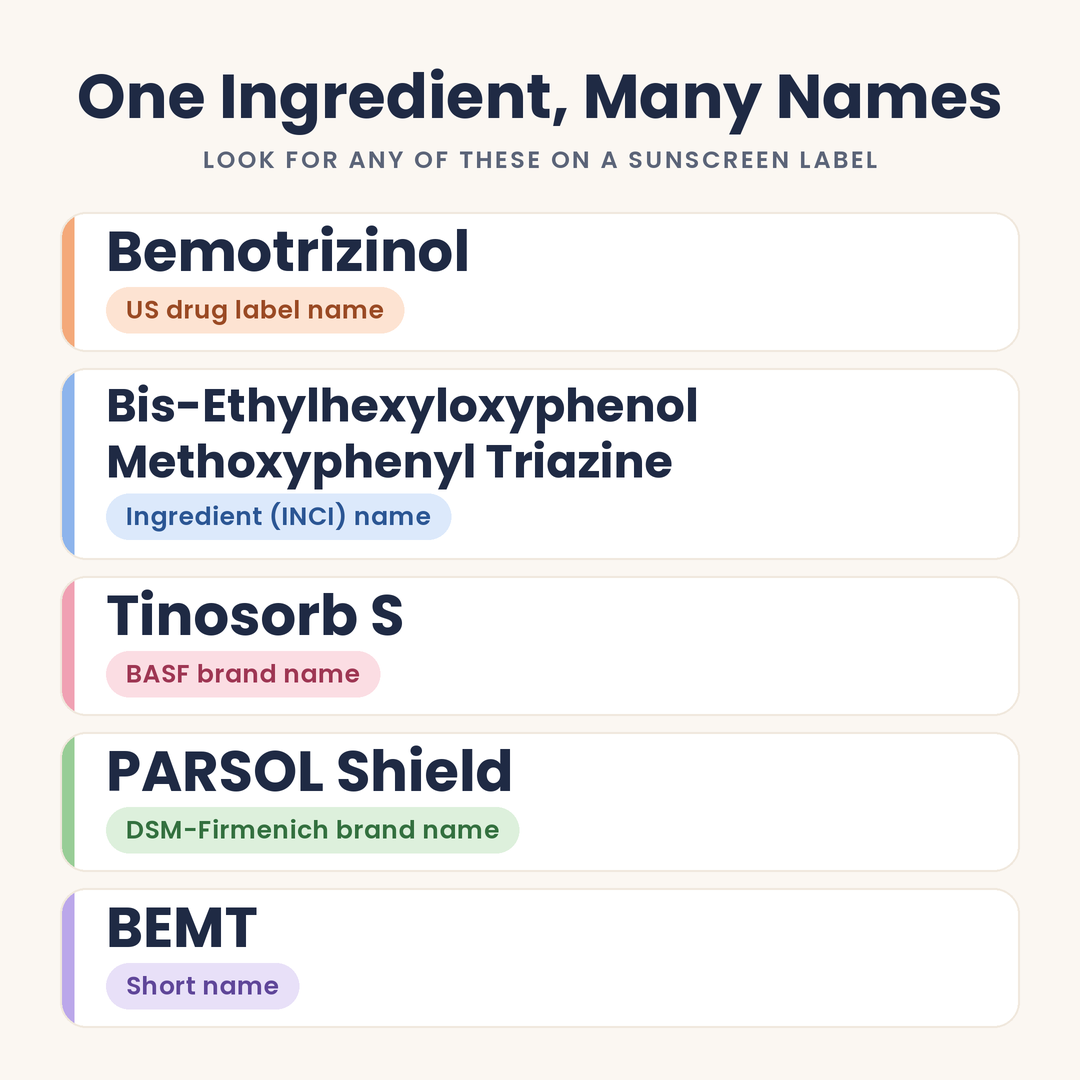
If you’ve seen headlines about the “first new sunscreen ingredient in 20 years,” this is the one. Its full name is bis-ethylhexyloxyphenol methoxyphenyl triazine, and you may also see it called Tinosorb S, PARSOL Shield or BEMT.
It’s a chemical (also called organic) filter, which means it’s made in a lab, unlike minerals like zinc oxide. It’s designed to soak up UV light and release the energy as a tiny bit of heat. It’s said to cover both UVB, which causes burning, and UVA, which goes deeper and causes most of the aging we see, like wrinkles, sagging and dark spots.
Where You’ll Find It: It’s been in European, Australian and Asian sunscreens for over 20 years. In the US, it was allowed in sunscreens starting August 9, 2026, at up to 6% (Europe allows up to 10%).
This post may contain affiliate links & I will earn a small commission if you purchase through them.
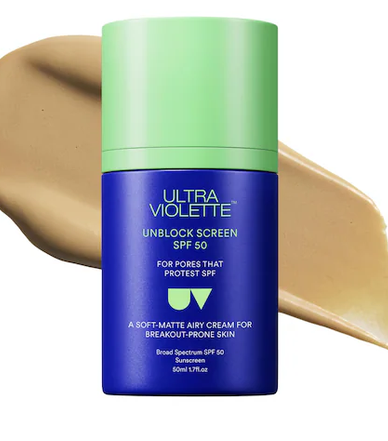
The First US Product With It: Ultra Violette Unblock Screen SPF 50 was the first sunscreen in the US to use bemotrizinol, and it also has zinc oxide in it.
I’m not recommending it, since I haven’t tried it and I’m sticking with mineral.
But, if you want to see what a bemotrizinol sunscreen looks like, this is the one.
Expect more brands to follow once the 18-month exclusivity period ends.
How Much Research Was Done?
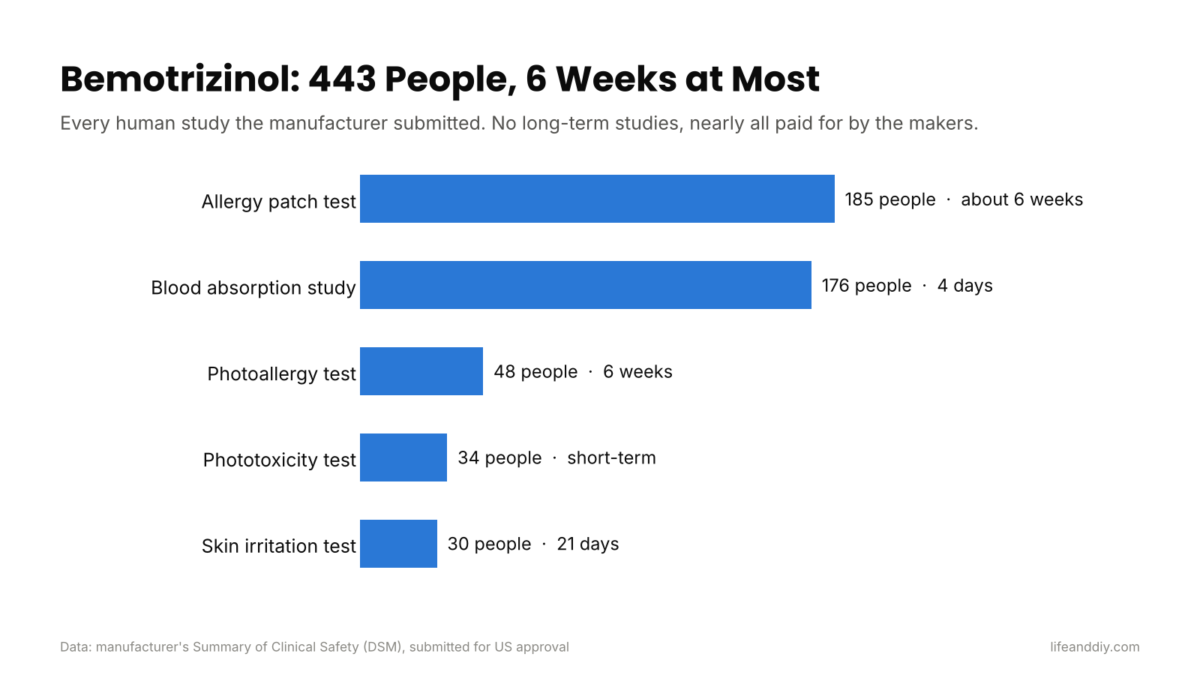
This is the part that matters most, because “approved” can sound like a lot more than it is. Here are the human studies listed in the safety summary the manufacturer submitted:
- Blood absorption study: 176 people, 4 days
- Allergy patch test: 185 people, about 6 weeks
- Skin irritation test: 30 people, 21 days
- Sun reaction tests: 34 people and 48 people (the longest lasted 6 weeks)
That’s 443 people total, and none of them were followed for more than about 6 weeks. There are no long-term studies in people.
What They Reported: The manufacturer reports no irritation or allergies in the patch and sun reaction tests. But, in the 4-day absorption study, 38% of people had mild skin reactions, mostly itching (about 1 in 10) and rash (about 1 in 12). They were applying a lot of product four times a day, and the report doesn’t compare it to the same formula without bemotrizinol, so we don’t know what caused it.
Who Paid for It: Almost all of the safety research was done or paid for by the companies that make it (Ciba, then BASF and DSM). That’s how most ingredients get approved, but I couldn’t find any independent studies in people.
How It’s Claimed to Be Different From Oxybenzone and Other Chemical Filters
Bemotrizinol is a chemical filter, but the manufacturer claims it behaves differently from the ones many of us try to avoid. Everything in this section comes from those same small, company-funded studies.
It’s Said to Be Too Big to Get Through Skin Easily: It’s a much bigger molecule than oxybenzone (a molecular weight of about 628 vs 228). Molecular weight is basically how big a molecule is, and the claim is that molecules over about 500 have a hard time getting through skin. In the manufacturer’s lab tests on donated human skin, they reported that less than 0.6% made it through.
They Claim It Barely Gets Into the Blood: In the manufacturer’s 4-day study of 176 people, they reported that only 3% of blood samples reached the level where more safety testing would normally be required (0.5 ng/mL). For comparison, a 2020 study of 48 people found that six common chemical filters all went above that level after just one application, and oxybenzone reached about 258 ng/mL. Both studies are small and short, so neither tells us what happens over years of use.
Hormone Testing Was Never Done in People: None of the human studies looked at hormones. The only hormone testing was done in a lab and in rats, between 2001 and 2002, by labs working for the manufacturer. In those tests, they reported it didn’t bind to estrogen or testosterone receptors or cause estrogen-like effects in the rats. A 2013 Danish review of that same data agreed it showed no estrogen activity, but noted no animal studies had looked at testosterone-related effects. Rats aren’t humans, so this only tells us so much.
It’s Said to Hold Up in the Sun: In one lab test by the manufacturer, they reported that about 98% of it was still intact after strong UV exposure. That wasn’t tested on skin or in real outdoor conditions.
The Animal Studies
The manufacturer submitted a set of animal studies, including a 2-year skin cancer study in rats, pregnancy and fertility studies in rats and rabbits, and a 9-month skin study in minipigs. They reported no problems, even at very high doses. Most were done between 1997 and 2006, all by or for the manufacturer, and one mouse cancer study was skipped altogether. Again, animals aren’t people.
Other Things to Know: After more than 20 years on the market in Europe, the manufacturer found only 2 published allergy cases, but published case reports usually catch only a small fraction of real reactions. Its chemical safety label also says it’s harmful to aquatic life with long-lasting effects, and the only environmental assessment I found was done by the manufacturer. There’s no data on breast milk and limited data on children.
How Much Research Is Behind Oxybenzone and Avobenzone?
If you’re wondering how this compares to the chemical filters already in most drugstore sunscreens, it’s not reassuring either.
Not Enough Data: In 2019, US regulators said they didn’t have enough safety data to call 12 common chemical filters safe and effective, including oxybenzone and avobenzone. Only zinc oxide and titanium dioxide made the cut. They asked manufacturers for absorption, cancer and pregnancy studies, and as of today, that’s still not resolved. Those filters are still on shelves.
Oxybenzone: It’s been used for decades, and a CDC survey found it in about 97% of Americans tested. The one hormone study in people I found had just 32 people for 2 weeks, using 10% oxybenzone, and it reported no hormone changes linked to the sunscreen. But, in 2025, Europe’s chemicals agency identified it as an endocrine disruptor (a chemical that interferes with hormones), mostly based on animal studies. Hawaii has also banned it since 2021 because of concerns about coral reefs.
Avobenzone: It’s been allowed in the US since 1988 and is the most common UVA filter in chemical sunscreens. It breaks down in sunlight unless it’s paired with other ingredients to stabilize it, and in the 2020 study, it got into the blood at 7 to 14 times the testing threshold after one application. Beyond absorption studies, there’s very little published safety research on it in people.
So, the older filters have decades of use behind them, but they’ve never had the full set of modern safety studies. Bemotrizinol has more formal testing than they do, but that testing is still small, short and mostly paid for by the people selling it.
How It Compares to Zinc Oxide
Even if every claim about bemotrizinol holds up, it doesn’t protect you better than zinc oxide. Zinc oxide also covers both UVA and UVB, including the longer UVA rays many chemical filters miss. What bemotrizinol offers is texture. It doesn’t leave a white cast and it feels lighter, which is why some people prefer it.
UVA is a big part of sun damage, dark spots and uneven skin tone, and it goes through windows and clouds, so the protection only helps if you actually wear it.
What I Use Instead
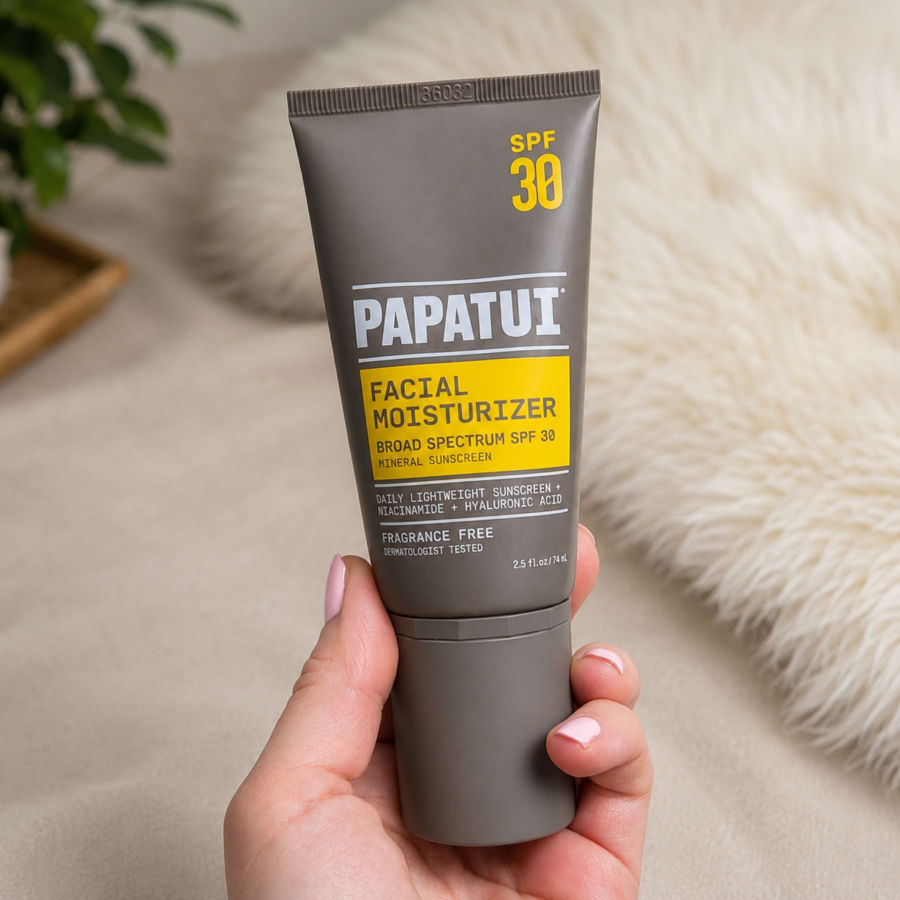
I’m sticking with mineral sunscreen, and right now I use two.
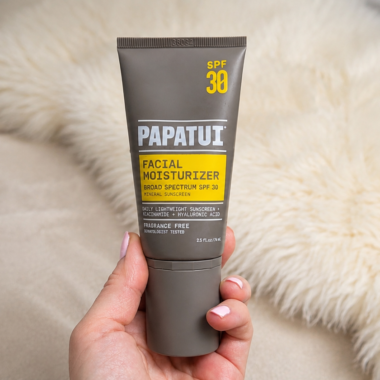
For my face, I use Papatui Facial Moisturizer with SPF 30. It’s 17% zinc oxide, it’s labeled broad spectrum, and it doesn’t have microplastics, petroleum or chemical filters.
It’s lightweight and doesn’t leave me greasy. You can read my full Papatui review for more.
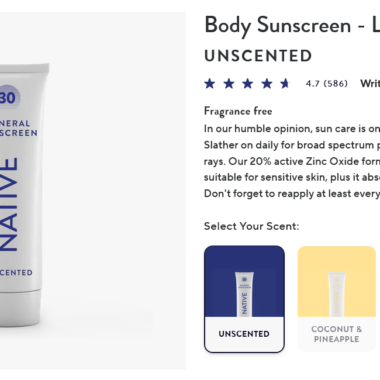
For my body, I use Native’s original mineral sunscreen, the 20% zinc oxide formula that’s microplastic free. Native has since changed the formula, but the original is still available for now, so I’m sticking with it. Who knows, maybe they’ll keep selling it instead of discontinuing it.
About the New Native Formula: The new version has polyacrylamide, a plastic-based ingredient. According to the cosmetic industry’s safety panel, polyacrylamide molecules are too large to get through your skin. But, it can contain tiny leftover amounts of acrylamide, the ingredient it’s made from, and that can get through skin. There are limits on how much is allowed, but it’s not something I want on my body every day, so I’m staying with the original formula as long as I can.
In an ideal world, I’d avoid microplastics in all of my skincare, but right now it’s really tough. I’m hoping that changes as more people become aware of it.
Who Might Want to Try Bemotrizinol?
If you feel okay with the very limited research, and you can’t stand mineral sunscreens, it may be a better choice than the older chemical filters, since it’s claimed to absorb much less. If you’re happy with zinc oxide, I don’t see a reason to switch. And if you’re pregnant, breastfeeding or have very sensitive skin, it’s worth asking your doctor, since there’s no long-term or pregnancy data in people.
Final Thoughts
I’m a big skeptic when it comes to new ingredients, and this one was tested on 443 people for a few weeks at most, almost entirely by the companies selling it. That’s not enough for me to trust it long term, so I’m staying with zinc oxide.
Would you try a sunscreen with bemotrizinol, or are you sticking with mineral? Let me know in the comments!
Sources
- Manufacturer’s Summary of Clinical Safety
- Manufacturer’s Nonclinical (Animal and Lab) Overview
- Final Order (US Approval Details)
- Matta et al., JAMA 2020 (Absorption of Six Chemical Filters)
- Danish Centre on Endocrine Disrupters, UV Filter Report (2013)
- C&EN, 2019 Proposed Sunscreen Rule
- FDA 2019 Sunscreen Fact Sheet
- EWG Summary of CDC Oxybenzone Data
- Janjua et al., J Invest Dermatol 2004
- ECHA Oxybenzone Endocrine Disruptor Conclusion (2025)
- Oxybenzone
- Avobenzone
- Bemotrizinol
- Ultra Violette US Launch
- CIR Safety Assessment of Polyacrylamide