Exosome Serums: What's Actually in the Bottle?
Exosomes are the hot new skincare ingredient, but the FDA says no exosome products are approved. Here’s what’s really in most serums and what to ask before using them with microneedling.

Some links in this post are affiliate links. I may earn a small commission at no extra cost to you.
On this page

Why Everyone’s Talking About Exosomes
Exosomes are everywhere right now. Med spas are adding them after microneedling, and you can find exosome serums at every price, from drugstore bottles to ones that cost a few hundred dollars. The promise is better healing, more collagen and a glow that lasts.
Since I do microneedling at home, I wanted to know what’s actually in these bottles and whether the hype holds up. The short answer is that the science is interesting, but the products have gotten way ahead of the research.
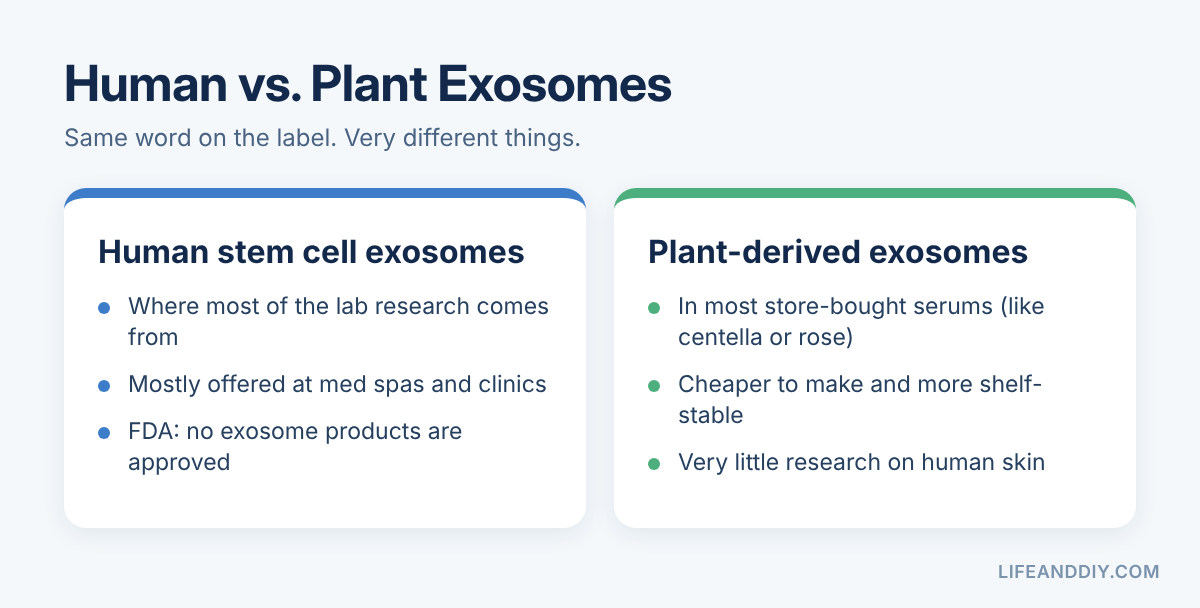
Exosomes are tiny packages cells use to send signals to each other. The FDA says there are no FDA-approved exosome products. Most serums you can buy use plant-derived “exosomes,” which are a different thing from the human stem cell exosomes used in a lot of the research. If you microneedle, be extra careful about what you put on your skin. I’ve switched to plain sterile saline.
What Exosomes Actually Are
Your cells release tiny bubbles called exosomes that carry proteins, fats and genetic material from one cell to another. Think of them like little messengers. In lab studies, exosomes from human stem cells have helped with wound healing and collagen, and that’s where most of the excitement comes from.
But “exosome” on a label can mean very different things depending on where it came from and how it was made. Two bottles with the same word on the front may have very little in common.
What the FDA Says
This part surprises a lot of people. The FDA issued a public safety notification back in December 2019 after several patients in Nebraska had serious reactions to unapproved exosome products. In that notice, the FDA said plainly that there are no FDA-approved exosome products.
Since then, the FDA has sent warning letters to companies selling exosome products, including one 2023 letter to a company that said its exosomes were for cosmetic use while also marketing them for skin damage. The FDA’s consumer page lists infections among the problems it has received reports about with unapproved regenerative products like these.
What’s in Most Store-Bought Serums
Most exosome serums you can buy online or at Sephora use plant-derived exosomes, often from things like centella (cica) or rose. Brands often choose these because they’re cheaper to make, last longer on the shelf and have fewer regulatory hurdles. A cosmetic chemist from the University of Cincinnati pointed out that quality can vary a lot between them.
Plant exosomes aren’t the same as the human stem cell exosomes used in much of the research, so you can’t borrow those results and assume they apply. A 2024 review of exosomes in cosmetic dermatology found a lot of promise but said there’s still very little clinical evidence on human skin, and that more human studies are needed. That doesn’t mean a plant exosome serum is bad. It may be a perfectly nice serum. It just means the exosome part is more of an unknown than the marketing makes it sound.
If You Microneedle, Read This
This is the part that matters most if you microneedle at home. Microneedling opens up tiny channels in your skin, so whatever you put on right afterward goes deeper than it normally would. That’s why the post-procedure products used by clinics matter so much, and it’s also why anything you put on freshly needled skin should be clearly labeled, sterile and made for use on broken skin.
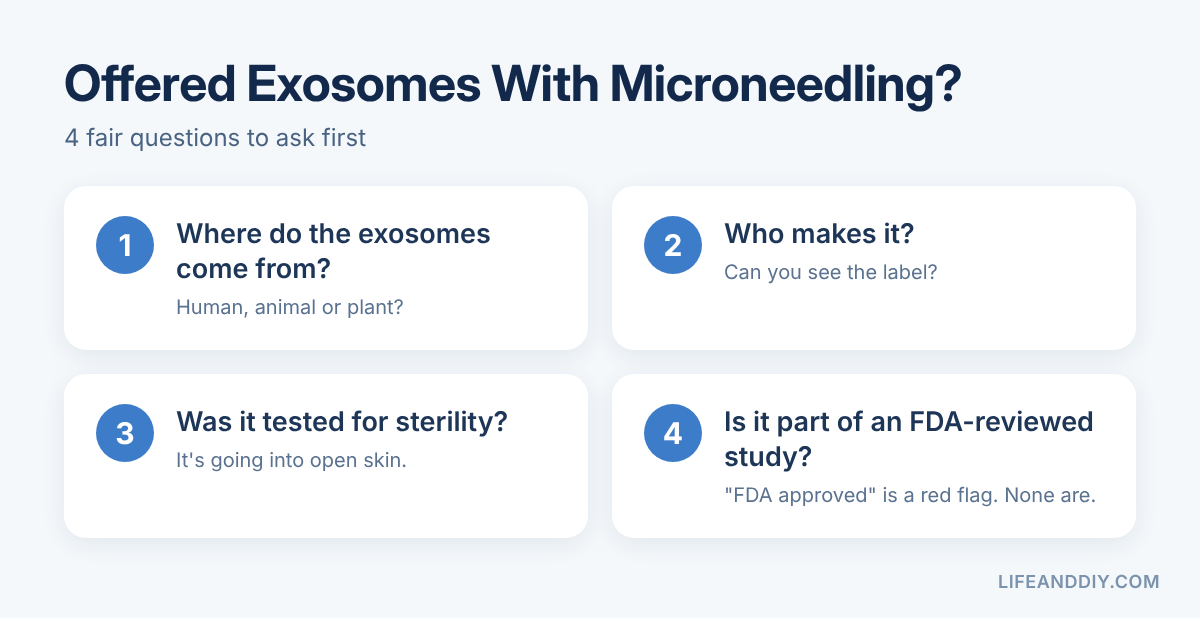
If a med spa offers exosomes with your microneedling, it’s fair to ask a few questions first:
- What’s the source of the exosomes (human, animal or plant)?
- Who makes the product, and can you see the label?
- Was it tested for sterility?
- Is it part of an FDA-reviewed study? (If they say it’s FDA approved, that’s a red flag, since none are.)
A good provider won’t mind these questions at all.
What I Use Now When I Microneedle: Sterile Saline
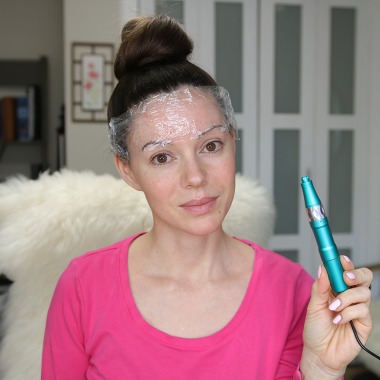
Lately, I’ve switched to plain sterile saline when I microneedle with my Hydra Pen H6. I want to be super safe, and I don’t trust most of the products out there to go into freshly opened skin. I use these sterile saline ampoules. The box comes with 20, and I use one or two per treatment.
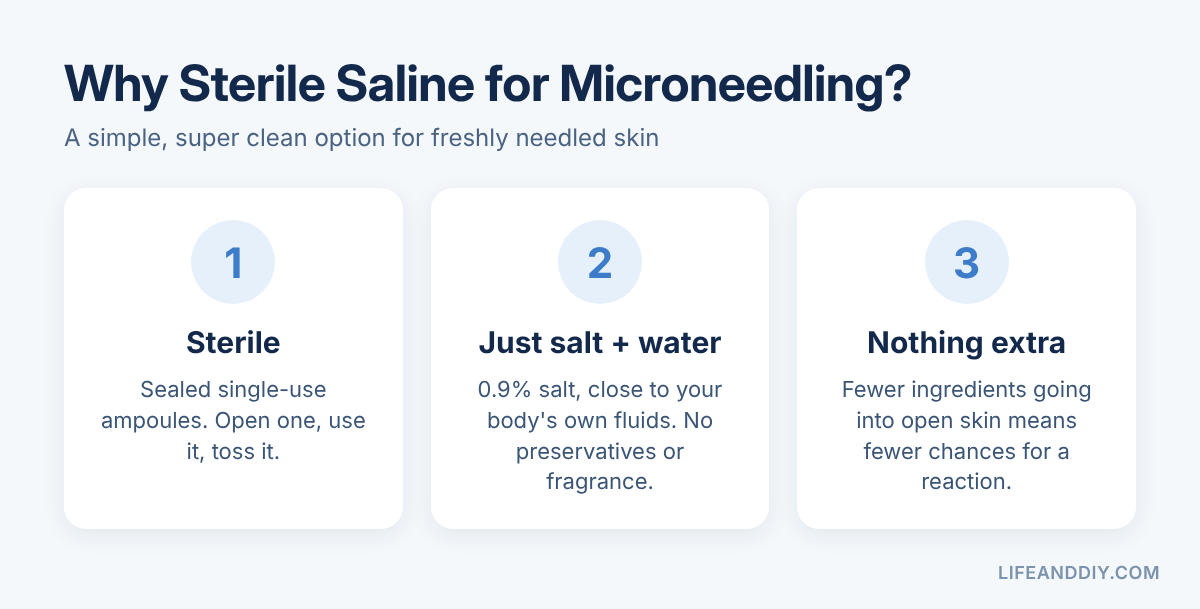
Here’s why saline is such a clean option:
- It’s sterile. Each ampoule stays sealed until you open it, and you use it once, so there’s no open bottle sitting on the counter collecting bacteria.
- It’s just salt and water. Sterile saline is usually 0.9% salt, which is close to your body’s own fluids, so it’s gentle on freshly needled skin. There are no preservatives, fragrance or plant extracts.
- There’s nothing extra to react to. The fewer ingredients going into open skin, the fewer chances for a bad reaction.
That last point isn’t just a theory. In a 2014 report, three women developed stubborn inflamed bumps called granulomas on their faces after microneedling with products that weren’t made to go into the skin, including a vitamin C serum. The doctors who wrote it up said that putting products on before microneedling can carry particles deeper into the skin and set off a reaction. A 2021 review of 85 studies found microneedling is fairly safe overall, but it advised caution when it’s combined with products that aren’t approved for use inside the skin.
Final Thoughts
Exosomes are one of the more interesting areas in skin research, and research is still ongoing. But right now, most of what’s for sale is ahead of the evidence. If you love an exosome serum you’re using, great. Just know you’re mostly paying for the rest of the formula, and be cautious about using anything new on freshly microneedled skin.
Have you tried exosomes, either at home or at a med spa? Tell me in the comments!
Sources
- FDA, Public Safety Notification on Exosome Products (December 2019)
- FDA, Important Patient and Consumer Information About Regenerative Medicine Therapies
- FDA Warning Letter to Kimera Labs (September 2023)
- Bai et al., Skin Health and Disease 2024 (Clinical Applications of Exosomes in Cosmetic Dermatology)
- University of Cincinnati, What Are Exosomes, and Do They Really Make Skincare Products Better? (2025)
- Soltani-Arabshahi et al., JAMA Dermatology 2014 (Granulomas After Microneedling With Topical Products, 3 Patients)
- Chu et al., Dermatologic Surgery 2021 (Safety Profile for Microneedling: A Systematic Review of 85 Articles)