iRestore Laser Face Mask Pro Review: A Closer Look at the Lasers (First Impressions)
I went looking for the most advanced, feature-rich LED mask I could find, and the iRestore Laser Face Mask Pro stood out: 150 low-level lasers, 8 wavelengths and a lot of power. Here’s a closer look.

Some links in this post are affiliate links. I may earn a small commission at no extra cost to you.
On this page
Why This Mask Truly Stands Out
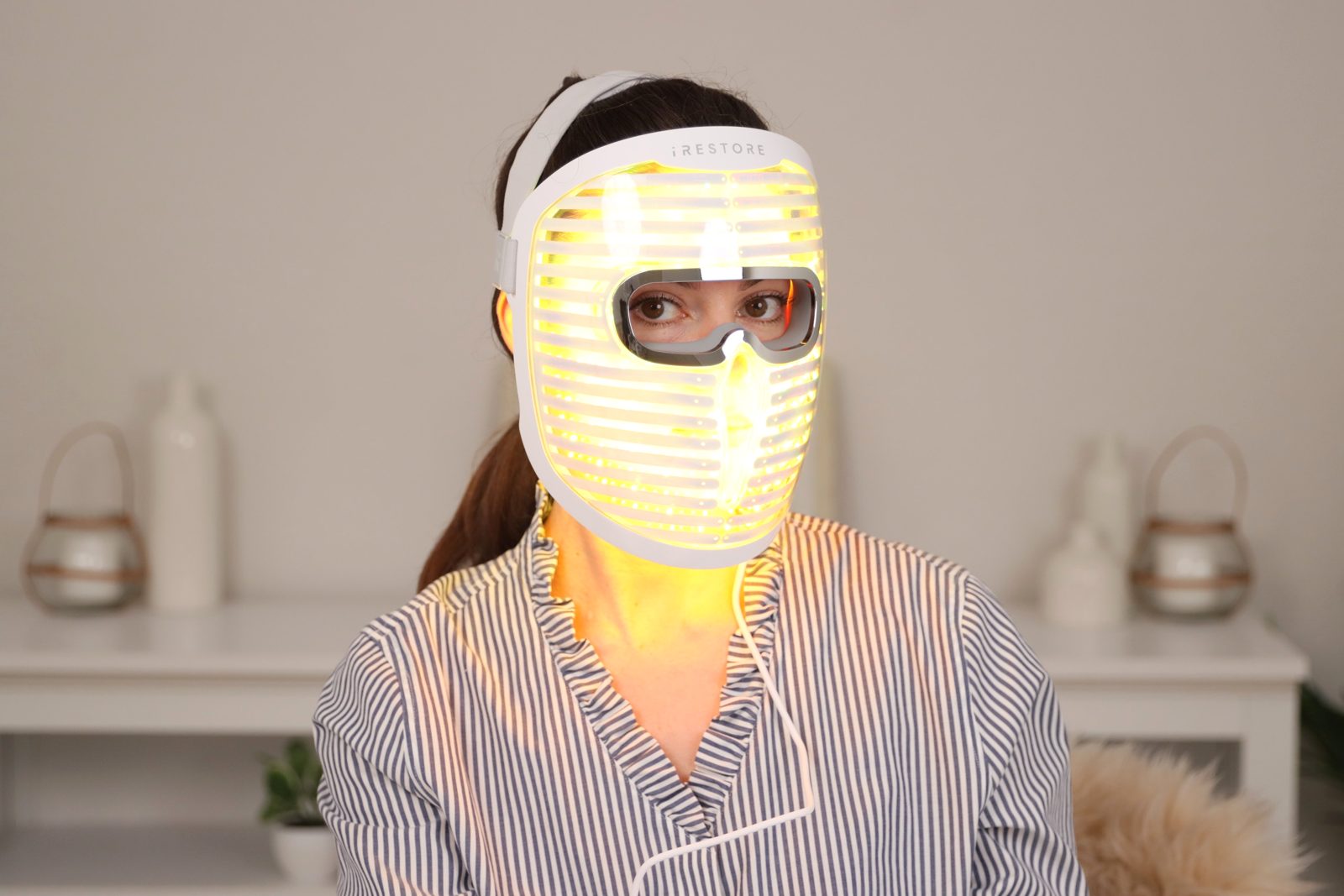
When I started researching LED masks, I wasn’t looking for just any mask. I wanted the best one I could find: the most advanced, most feature-rich and most unique option out there. After comparing a lot of them, the iRestore Laser Face Mask Pro is the one that really stood out.
It’s powerful. Most masks use LEDs alone, but this one adds 150 low-level laser diodes to its 650 LEDs, runs eight different wavelengths, and puts out 70 to 126 mW/cm² depending on the mode, which is high for a mask you use at home. On paper, it’s in a different league from the typical LED mask.
iRestore sent me this mask as a gift after I reached out to them. They didn’t pay me to write this. I’ve only been using it for a short time, so this is a close look at what makes it special and what it’s like to wear, not a final verdict on results.
This mask has 800 lights, and 150 of them are low-level laser diodes. It has eight wavelengths, five modes and a lot more power than most masks. It’s a rigid shell with built-in eye shields, and it’s one of the most comfortable masks I’ve tried. The list price is $1,099. At full price, my code HOLLYSKIN takes about $400 off. If it’s already marked down (it’s $699 as I’m writing this), my code just gives you a few dollars more off: Shop the iRestore Laser Face Mask Pro
What the Research Says So Far
LED light therapy has been studied for years, and research is still ongoing. The strongest studies so far are for fine lines, texture and collagen. In a 2014 controlled study of 136 people, skin got smoother and collagen got denser after 30 sessions. In a 2025 study of 60 people, an at-home mask was compared to a fake one, and crow’s feet improved at 8, 12 and 16 weeks (that study was paid for by the mask’s maker). Blue light has also been studied for mild breakouts, but a 2019 review found the evidence is still limited.
Most of these studies are still fairly small, and the results build gradually, so consistency matters. The research points to regular use over a few months, not a couple of weeks, and that’s the mindset I’m going in with.
What Makes the iRestore Different
The first thing you notice is the design. It’s a firm, structured mask rather than a flexible one, and it rests slightly away from your skin with the mouth left open, so it never feels stuffy.
I’ve tried a number of LED masks, and most of them were the flexible silicone kind. I find those uncomfortable and confining, and they make me feel a little claustrophobic. That’s a big reason I prefer the iRestore’s structured design.
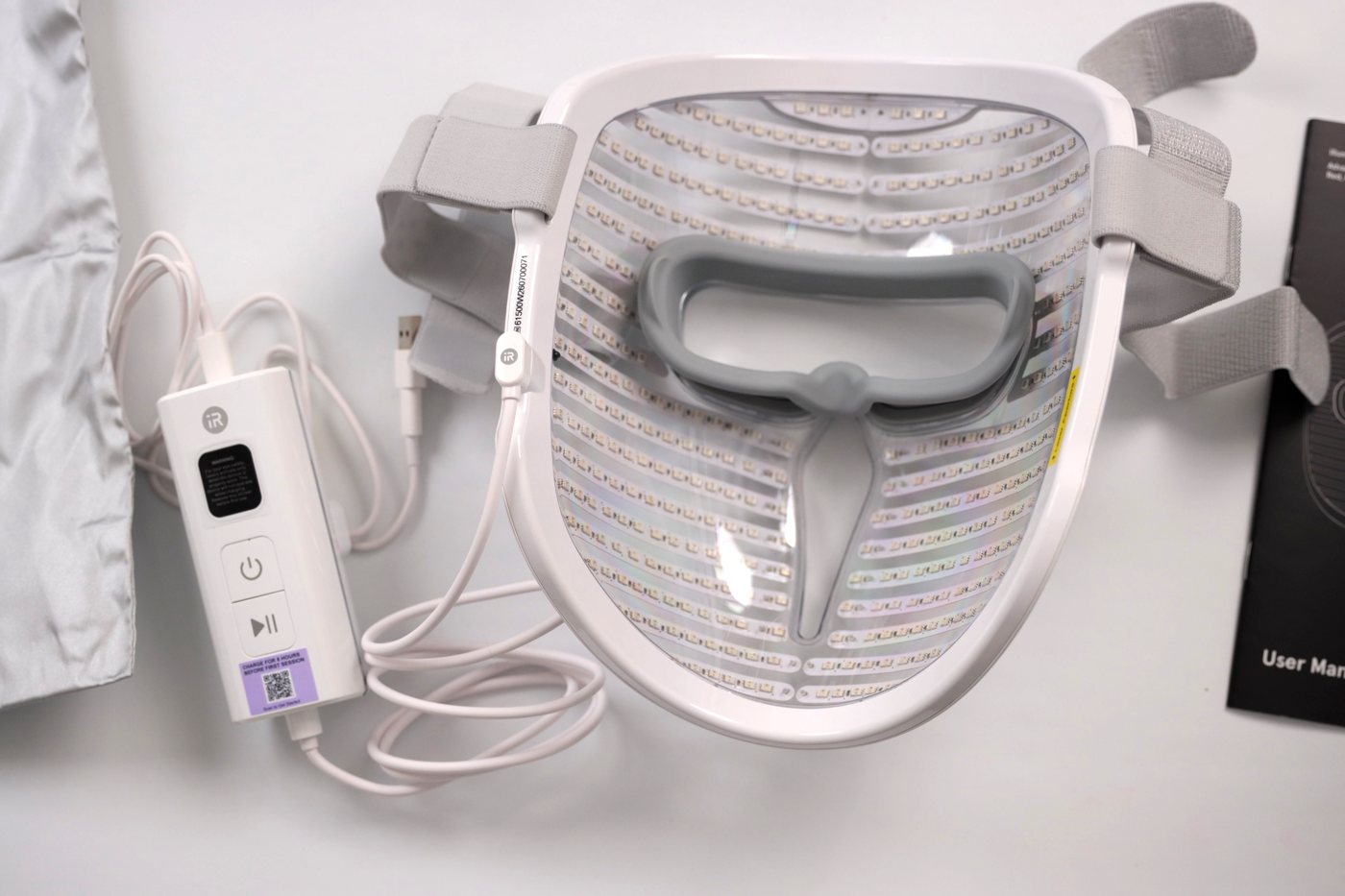
What really sets it apart is the combination of lights. You get 800 in total: 650 LEDs plus 150 low-level laser diodes, which you don’t see in most at-home masks.
Lasers vs. LEDs
If “laser” makes you think of a dermatologist’s resurfacing treatment, this is something very different. Low-level lasers are gentle and don’t heat or damage the skin, and they’ve been used for years in things like hair growth caps and devices for sore joints. According to iRestore, laser light is more concentrated than LED light, so it can deliver a more targeted dose.
The skin research on low-level lasers is still growing. One small 2024 study of 30 women used a 660 nm red laser (a wavelength this mask uses) for 12 sessions and reported better wrinkles and elasticity, though there was no comparison group. I haven’t found studies that test lasers against LEDs directly for skin, so I can’t tell you one beats the other yet. I just like having both in one device.
The 8 Wavelengths and 5 Modes
Most LED masks give you two or three colors. This one has eight wavelengths spread across red, near-infrared, deeper infrared, blue, green and amber, and you pick a mode based on what you’re working on:
Anti-Aging: red and near-infrared, aimed at fine lines and firmness.
Clear: the anti-aging lights plus blue, for breakout-prone skin.
Brighten: adds green, aimed at uneven tone.
Restore: green and amber, aimed at redness and dullness.
All Wavelengths: everything at once. Personally, I like this one because I don’t have to think about which mode to choose.
The lasers stay on no matter which mode you pick, while the blue, green and amber come from the LEDs.
Irradiance: The Most Important Number When Comparing LED Masks
If there’s one spec to check before buying any LED mask, it’s irradiance. It’s how much light power actually reaches your skin, measured in milliwatts per square centimeter (mW/cm²). The dose your skin gets depends on that power and how long you use the mask, so a weaker mask gives you a much smaller dose in the same 10 minutes. Many masks don’t list it at all, so it’s worth asking the brand before you buy.
This is where the iRestore really pulls ahead. It’s rated at 70 to 126 mW/cm², depending on the mode, which is in the same range as the professional LED panels used in dermatology offices (the Omnilux Revive, for example, is listed at 105 mW/cm² for red light).
Power isn’t everything, though. What your skin gets is the dose, which is power times time, and research suggests there’s a sweet spot, so more isn’t always better. If you have a weaker mask, you can still get results according to the research, but you’ll need to use it longer. In the 2014 study of 136 people, the red light was only about 7 to 13 mW/cm², but sessions ran 12 to 25 minutes, and skin still got smoother and collagen got denser. Higher power just means you get a real dose in a quick 10-minute session, and that’s why it’s the first number I look at.
Smart Little Details
A few small things show how much thought went into this mask. The charger connects with a magnet, so a tug on the cable won’t pull the mask off your face. There’s a sensor that keeps the lasers off until the mask is properly in place. The controller is cordless, so you can move around, and a session only takes 10 minutes, 3 to 5 times a week.
iRestore also backs it with a 2-year warranty and a 100-day money-back guarantee. For a device at this price, that peace of mind matters to me.
Are the Lasers Safe Near Your Eyes?
To be honest, the thought of lasers near my eyes made me really concerned and uncomfortable before I tried it.
According to the manual, these are Class 3R lasers, a category that also includes many everyday laser pointers. With normal use they’re considered low risk, but you’d never want to look straight into one. That’s where the built-in eye shields and the on-face sensor come in.
After my first session, my worries were gone. The shields block the light really well, and I didn’t see any glow around my eyes. Keep in mind that some of the light is infrared, which is invisible, so closing your eyes is an easy extra precaution, and it’s what I do.
If you’re extra cautious about your eyes like I am, you can also wear disposable adhesive eye shields made for laser, IPL and LED treatments. They’re opaque, so they block all the light, and they’re thin enough to fit under the mask. Just know they’ll also cover a bit of the under-eye area. If you have any eye condition, talk to your doctor before using it.
What It’s Like to Wear
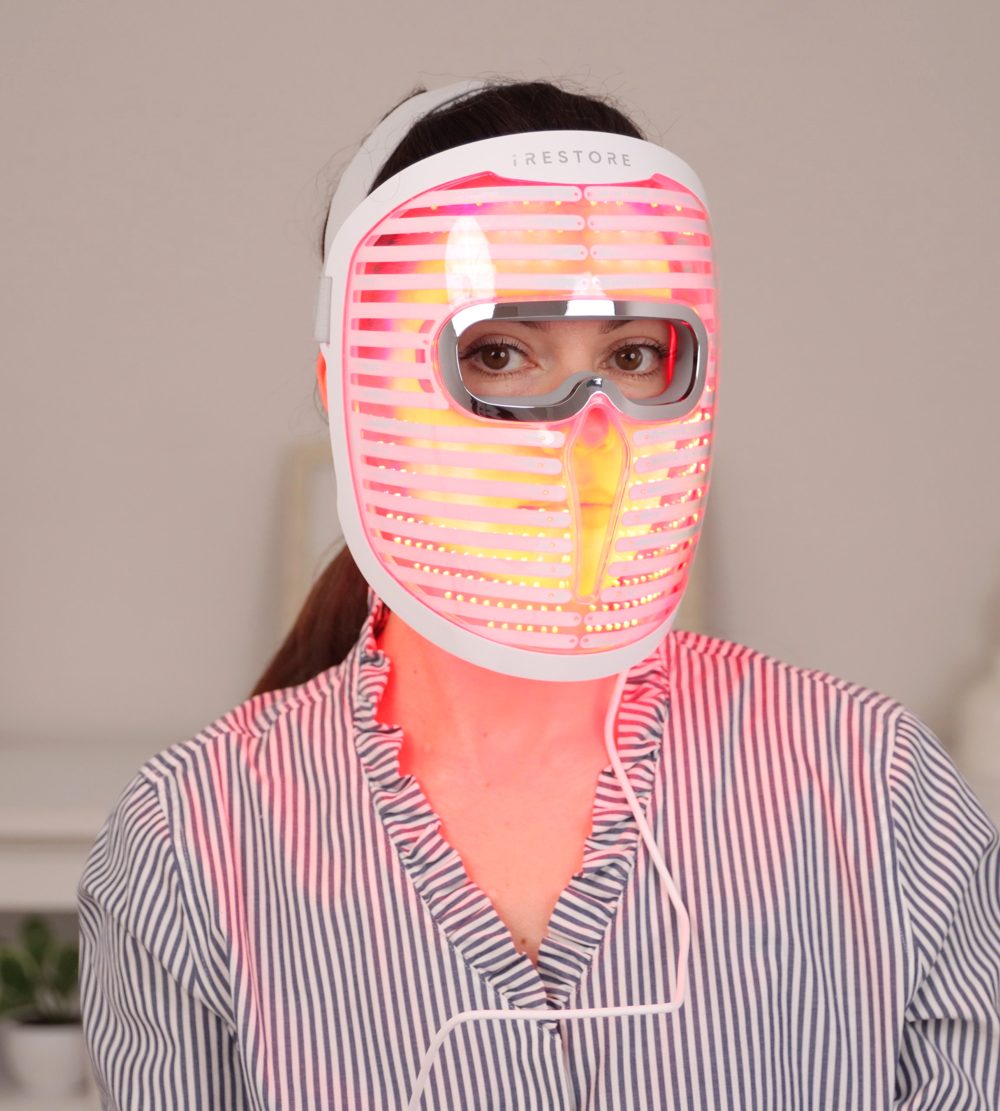
This is one of the most comfortable masks I’ve tried. I also have iRestore’s Illumina mask, which can press a little on the bridge of my nose, but the Pro adds a strap across the top of your head, so the weight is spread out evenly. Because the eye shields are part of the mask, you could even read or check email during a session if you wanted to.
My only wish is a little more coverage right under my eyes. The under-eye area is the spot I most want to treat, and I’m not sure the light reaches all the way up to my lower lash line. Shifting the mask up slightly helps cover it, so it’s an easy fix, and it doesn’t change how much I like this mask.
Who it might suit: someone who wants one of the most powerful masks available, likes having lots of modes in one device, and is comfortable with the idea of lasers in a face mask.
If You’re Shopping for an LED Mask
Two things are worth checking on any mask. First, the wavelengths. Red (about 630 to 660 nm), near-infrared (about 830 to 850 nm) and blue (about 415 nm) are the ones with the most research. The iRestore covers all three, and then some.
Second, the irradiance I covered above. If a brand doesn’t list it, ask before you buy.
Whichever mask you pick, using it consistently matters more than any spec. If you’re on a medication that makes you sensitive to light or you have an eye condition, ask your doctor first. And personally, I keep my eyes closed during every LED treatment.
Final Thoughts
I went looking for the most advanced mask I could find, and so far the iRestore Laser Face Mask Pro lives up to that. It’s powerful, packed with features and surprisingly comfortable. I’ll share an update once I’ve used it long enough to judge real results. Thank you to iRestore for sending it.
When it comes to LED masks, iRestore is the brand I trust. If you like the idea of a structured mask but aren’t comfortable with lasers, I’d check out their Illumina LED Face Mask. It’s LED only, with 360 LEDs in red, near-infrared and blue, and it’s rated at up to 60 mW/cm² in its all-wavelength mode.
Have you tried red light therapy, or are you thinking about it? Tell me in the comments!
🛒 iRestore Laser Face Mask Pro - code HOLLYSKIN
Sources
- Wunsch & Matuschka, Photomedicine and Laser Surgery 2014 (Red and Near-Infrared Light, 136 People)
- Park et al., Medicine 2025 (Home-Use LED Mask vs. Sham for Crow’s Feet, 60 People)
- Scott et al., Annals of Family Medicine 2019 (Blue-Light Therapy for Acne Review)
- Shurrab & Alzghayar, Journal of Cosmetic Dermatology 2024 (660 nm Low-Level Laser, 30 Women)
- iRestore Laser Face Mask Pro Product Page (Specs, Warranty and Guarantee)
- Recovery for Athletes, iRestore Illumina Face Mask Specs (360 LEDs, Irradiance by Mode)
- Omnilux Professional LED Spec Sheet (Revive 633 nm: 105 mW/cm²; Plus 830 nm: 55 mW/cm²)
- Huang et al., Dose-Response 2009 (Biphasic Dose Response in Low-Level Light Therapy)