


📌 Quick Overview
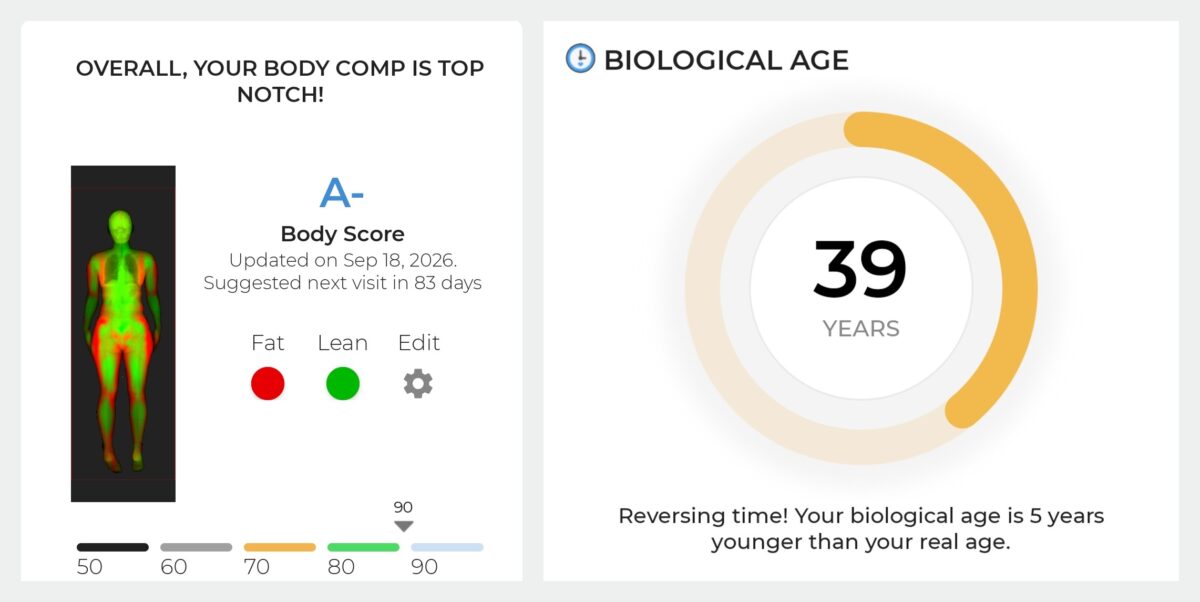
I got a whole-body DEXA scan at DexaFit about seven weeks into a new workout program. My bone density and visceral fat both came back in the excellent range. My body fat landed in the “fair” range, and my muscle came back below average for my height, which is what I’m focused on now.
Why This Matters as You Get Older
Bone loss after menopause: according to the Bone Health & Osteoporosis Foundation, a woman can lose up to 20% of her bone density in the five to seven years after menopause, and about one in two women over 50 will break a bone because of osteoporosis.[3]
Muscle loss: Harvard Health notes that after age 30, you can lose as much as 3% to 5% of your muscle mass per decade. Less muscle means more weakness and less mobility, which raises your risk of falls and fractures.[4]
Rebuilding muscle: Harvard Health also says “it is never too late to rebuild muscle and maintain it,” and strength training is one of the best ways to do it.[2]
You can’t see any of this in the mirror, which is why I wanted a baseline.
What a DEXA Scan Measures
DEXA stands for dual-energy X-ray absorptiometry. It sends two very low-dose X-ray beams through your body. Bone, fat, and muscle each absorb them differently, so the scan can separate your body into those three parts and show you where each one is.
A full-body scan shows you:
- Your body fat percentage and where your fat is stored
- Your lean mass (mostly muscle) in your arms, legs, and trunk
- Visceral fat, the fat packed around your organs
- Your bone density
A bathroom scale can’t tell you any of that. It can’t even tell you whether a gain is fat, muscle, or water.
Cost, Time, and Radiation
- Where: DexaFit, which has locations across the US. This isn’t sponsored. I found them on my own and paid for it myself.
- Cost: I paid $100 with a coupon that I found on their site during checkout.
- Time: about 25 minutes for the whole visit, and about 7 minutes for the scan itself. You fill out your info in their app beforehand.
- Radiation: a whole-body DEXA is about 3 to 5 microsieverts. That’s less than a single day of the natural background radiation you get just from living your life. A cross-country flight is about 35.
I’m normally really careful about unnecessary scans, especially CT scans, which use far more radiation. This one didn’t worry me.
How to Prep for an Accurate Scan
- Follow the prep instructions. DexaFit asks you to skip food for about two hours beforehand, stay hydrated, and wear workout or casual clothes with no metal.
- Don’t skip water. DEXA counts the water in your muscles as lean mass, so being low on fluids could make your muscle read a little lower than it really is.
- Skip the workout that morning, so your muscles aren’t holding onto extra fluid from training.
- Get your first scan before you start a new workout program, so you have a true starting point. I wish I had.
My Results, and What Each Number Means
Two Different Kinds of DEXA Scans
In May 2025, I had a bone density scan at Bangkok Hospital Hua Hin in Thailand. I thought I was getting the same kind of DEXA scan that places like DexaFit offer in the US, but it was a medical bone density scan. It only looked at my lower spine and hip, but in great detail. That’s the type of scan your doctor would order to check for osteoporosis, and it doesn’t measure fat or muscle at all.
DexaFit’s scan covers your whole body: body fat, muscle, visceral fat, and whole-body bone density. Its bone numbers are useful for context but aren’t used to diagnose osteoporosis. So the two scans are different, and you can’t compare the numbers directly.
Bone Density
Bone density was my top priority. I’ve been on thyroid medication for over a decade, and certain types of thyroid medications have a strong effect on your TSH (thyroid-stimulating hormone), which is one of the most common blood tests for thyroid function. Medications that contain T3, like liothyronine or natural desiccated thyroid, can push your TSH very low. This is called a suppressed TSH. Some doctors get concerned about this, because a suppressed TSH over the long term has been linked to bone loss.
Both of my scans came back in the normal range:
- Thailand, May 2025 (medical scan): my lower spine had a T-score of 0.7 and my hip had a T-score of 0.5.
- DexaFit, September 2026 (whole body): my T-score was 1.4 and my Z-score was 2.
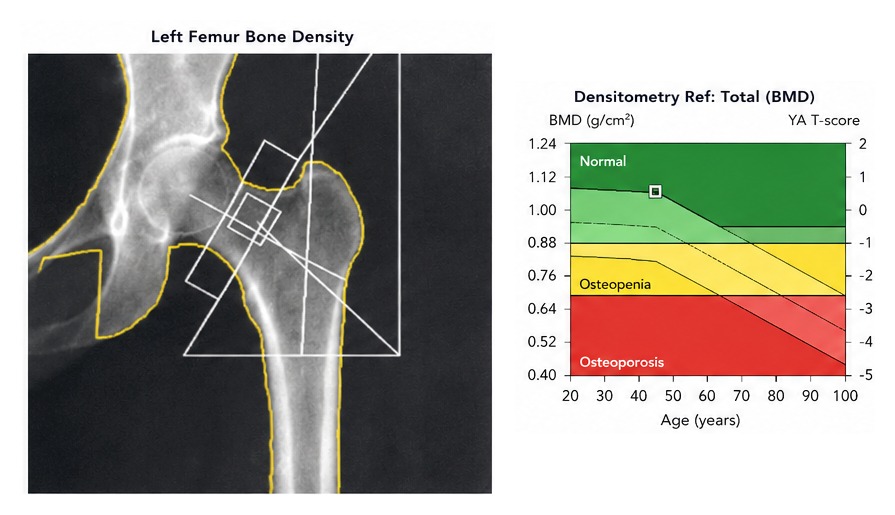
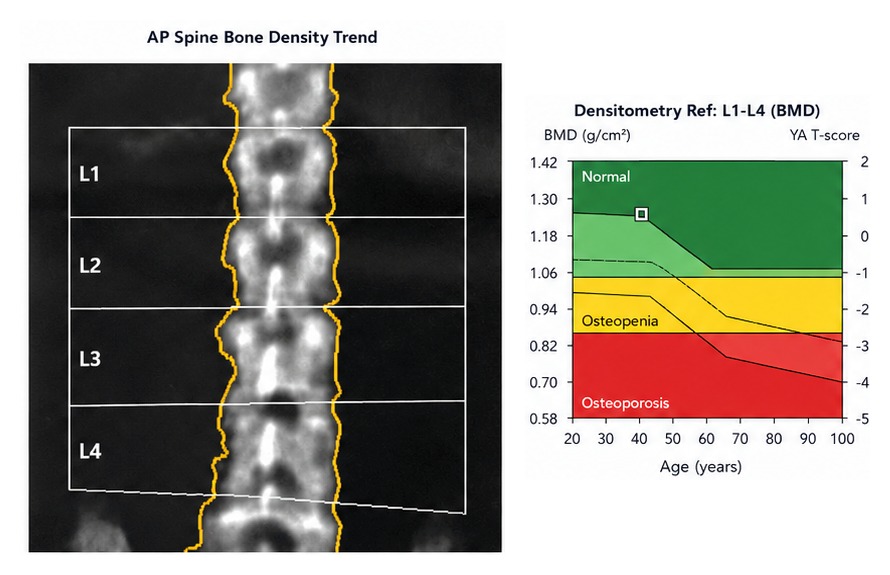
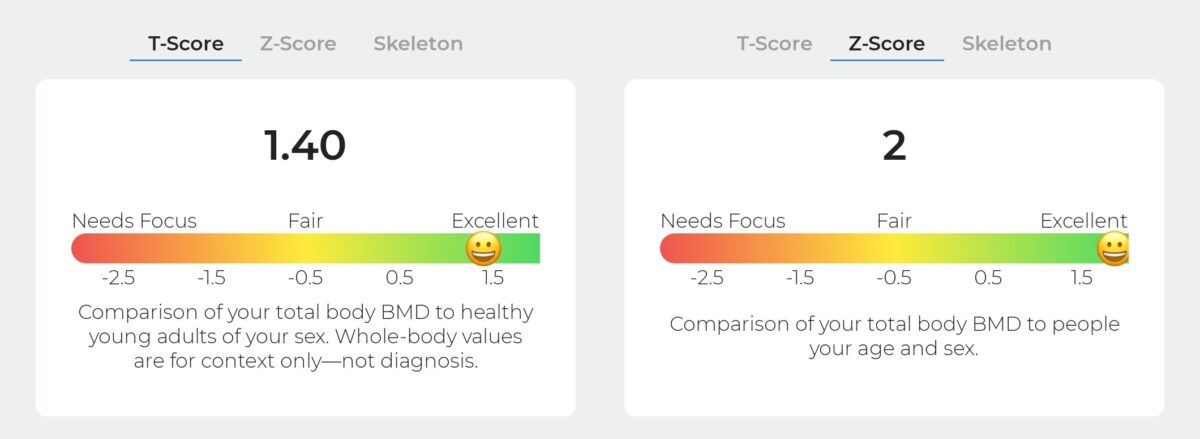
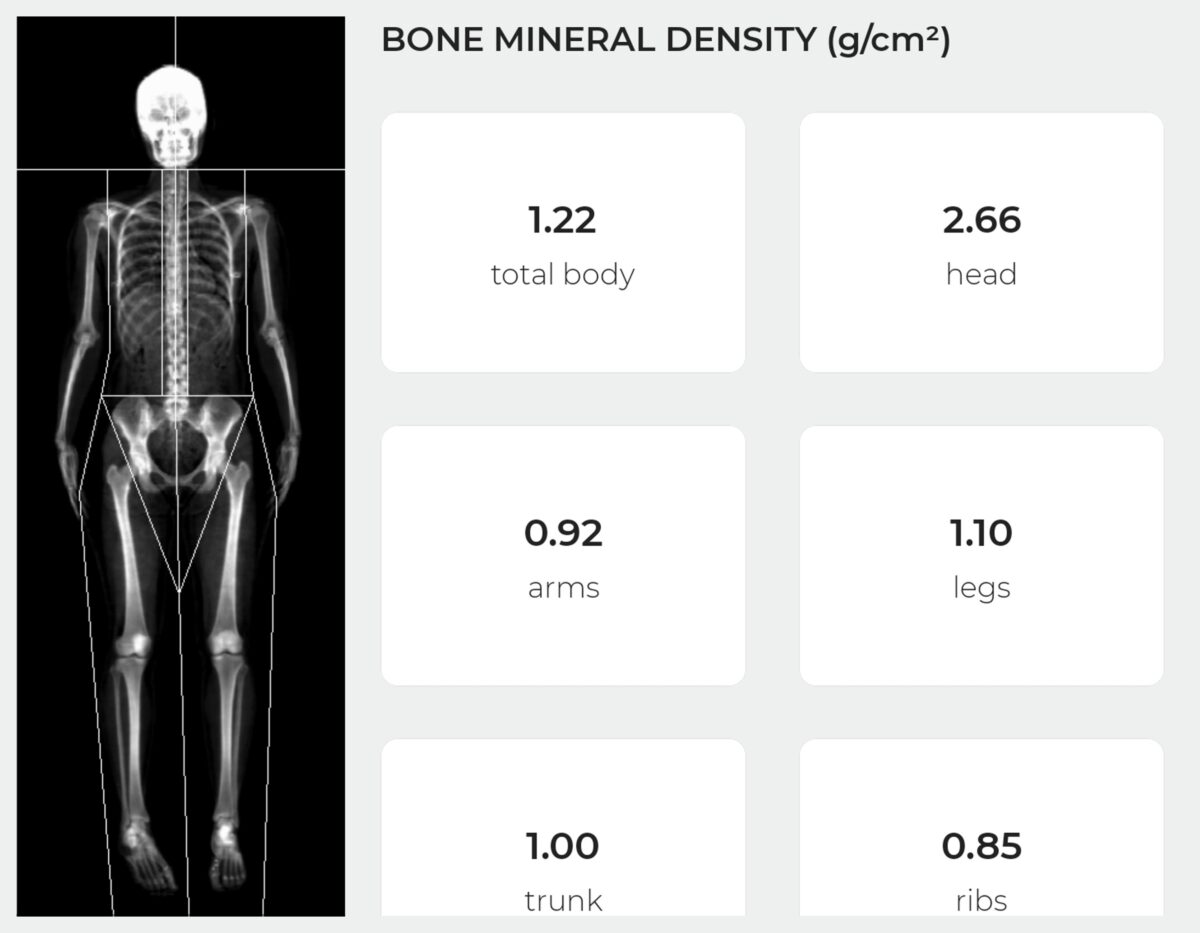
A T-score compares your bones to a healthy young adult of your sex, around the age when bone density peaks (roughly your 20s). Anything -1 or higher is considered normal, between -1 and -2.5 is osteopenia (low bone mass), and -2.5 or lower is osteoporosis. A Z-score compares your bones to people your own age and sex. Different machines also use slightly different reference groups for these comparisons, which is one more reason my two scans can’t be compared directly.
Visceral Fat
Visceral fat is the fat deep inside your belly, around your organs. It’s linked to heart disease, type 2 diabetes, and inflammation, and since you can’t see it in the mirror, a scan is one of the only ways to measure it.
Mine came back at 0.28 pounds. DexaFit’s average for my age group is about 1 pound, so I’m 73% under it. Eight years ago, a surgeon told me she barely saw any visceral fat during my surgery, when she usually sees a lot, so it was good to see that’s still true.
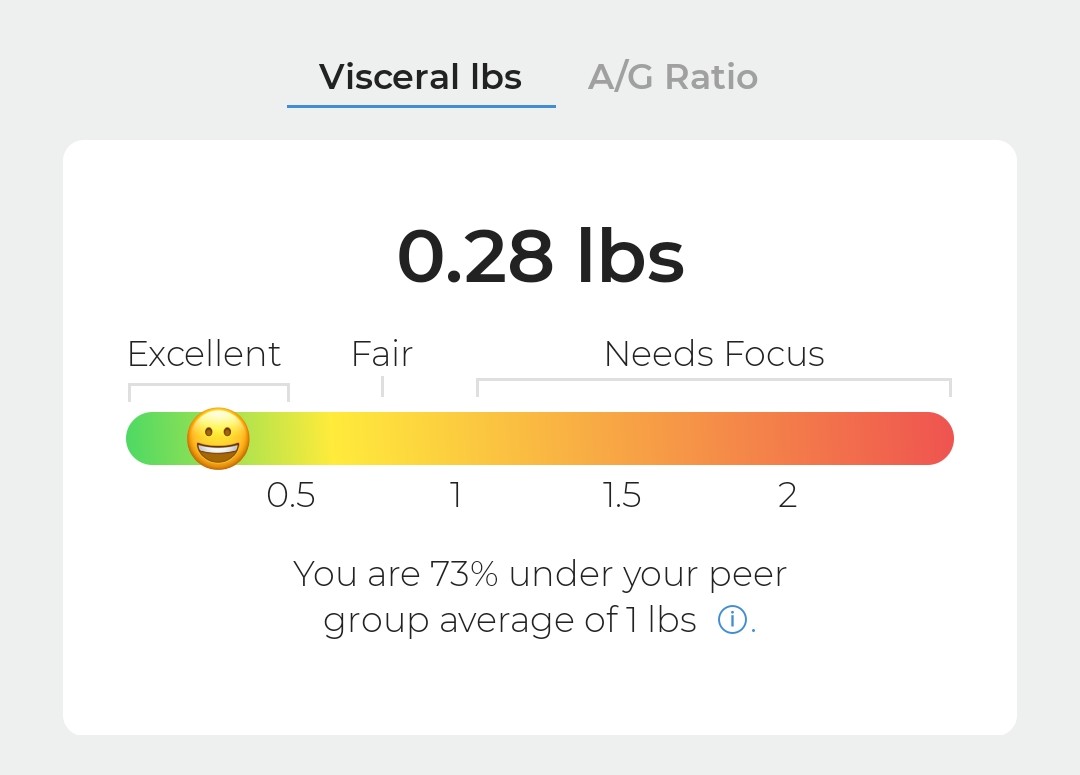
So what’s a normal amount? You actually need some visceral fat. According to the Cleveland Clinic, visceral fat is something everyone has, and it “cushions and protects your internal organs.”[1] Part of it forms the omentum, a fatty apron that hangs over your intestines. Researchers have nicknamed the omentum “the abdominal policeman,” because it can move to the site of an infection or injury inside your belly and help wall it off. In a 2021 study published in Frontiers in Immunology, mice without an omentum had a much harder time clearing a serious abdominal infection and were more likely to die from it.[2] So zero isn’t the goal.
The problem is having too much. One study of healthy, normal-weight women aged 20 to 40 found an average of about half a pound on a DEXA scan, and other studies put the point where metabolic syndrome risk goes up at around 2.4 pounds for women.
High cortisol is one of the biggest things linked to more visceral fat. When your main stress hormone stays high for a long time, your body tends to store more fat around your middle. Poor sleep can raise cortisol too, and research has linked sleeping less than five hours a night to more belly fat. The hormone changes around menopause also shift fat storage toward the belly. On the other side, regular walking and a mix of strength training and cardio have been shown to help keep it down.
Body Fat and Where It Is
Over the last year or two, I put on 10 to 15 pounds, and I’m only 5’2″, so I really noticed it. It felt like all of it went straight to my stomach and arms, so I was sure that’s where the scan would show most of my fat. I was wrong. The majority of my body fat is actually in my legs, especially my hips and outer thighs. That surprised me so much, and it’s a good reminder that what you see in the mirror doesn’t always match what’s really going on.
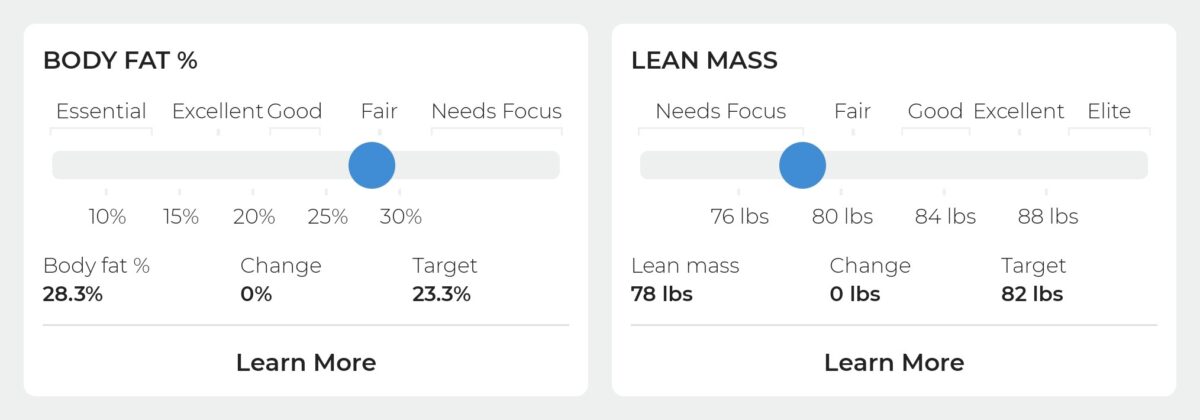
My body fat came back at 28.3%, which DexaFit calls “fair,” with a target of 23.3%. The person who went over my results said that’s totally normal for a woman. But I’m not used to carrying this extra weight, so my goal is to lose some fat while building muscle.
Muscle: ALMI and FFMI
This is where my results surprised me. My lean mass was 78 pounds, with a target of 82. These two numbers explain why:
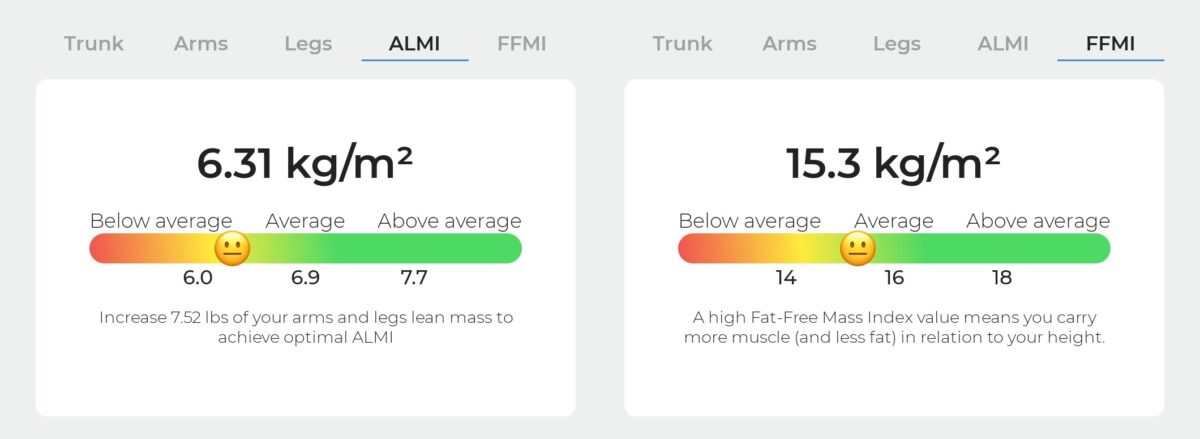
- ALMI (appendicular lean mass index): how much muscle is in your arms and legs compared to your height. Mine was 6.31, below the average of about 6.9, and the app says I’d need about 7.5 more pounds of muscle in my arms and legs to be optimal.
- FFMI (fat-free mass index): all your lean mass compared to your height. Mine was 15.3, just under the average of 16.
ALMI matters as you get older because it’s used to screen for sarcopenia, which is age-related muscle loss. The cutoff used for women is an ALMI of about 5.5, so I’m comfortably above it. But below average isn’t where I want to be.
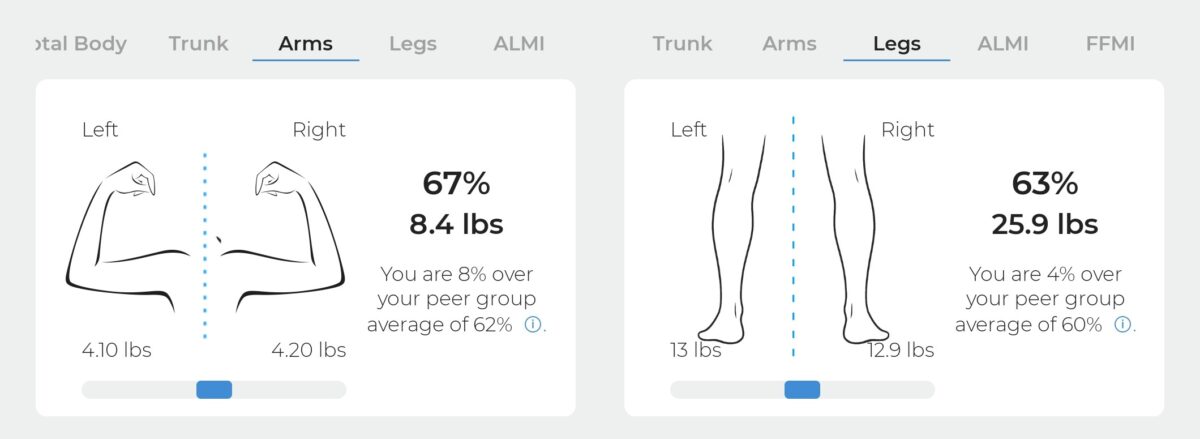
On the plus side, my left and right sides are almost perfectly even. My legs came back at 13 and 12.9 pounds of lean mass, and my arms at 4.1 and 4.2.
Final Thoughts
If healthy aging is important to you, I think it’s so important to have a baseline measurement of your health as you get older, and a DEXA scan is one of the absolute best ways to get one. You can’t see your bone density or how much muscle you have by looking in the mirror, and the scale definitely won’t tell you.
I think knowing your bone density is just as important as knowing how much muscle you have. Both tend to decline as you age, and you don’t want to find out your bones are weak after you’ve already broken one. Muscle matters so much more than most people realize. It keeps you strong and independent, and it’s something I’m now working hard to build. Visceral fat is another big one, because it can be a sign that something isn’t working right in your body, even if you look healthy on the outside.
Now that I have my baseline, I’m planning to get another scan in about three to six months to see if all this work is paying off. I’ll share my results when I do. I wish it wasn’t so far from my home. When I did this test, I had to drive for about 10 hours total in two days! I’m still glad I did it though.
Have you ever had a DEXA scan, or is it something you’ve been thinking about? Let me know in the comments.
Sources
- What Women Need to Know (Bone Health & Osteoporosis Foundation)
- Preserve your muscle mass (Harvard Health)
- Visceral Fat: What It Is & How It Affects You (Cleveland Clinic)
- The Essential Involvement of the Omentum in the Peritoneal Defensive Mechanisms During Intra-Abdominal Sepsis (Frontiers in Immunology, 2021)


