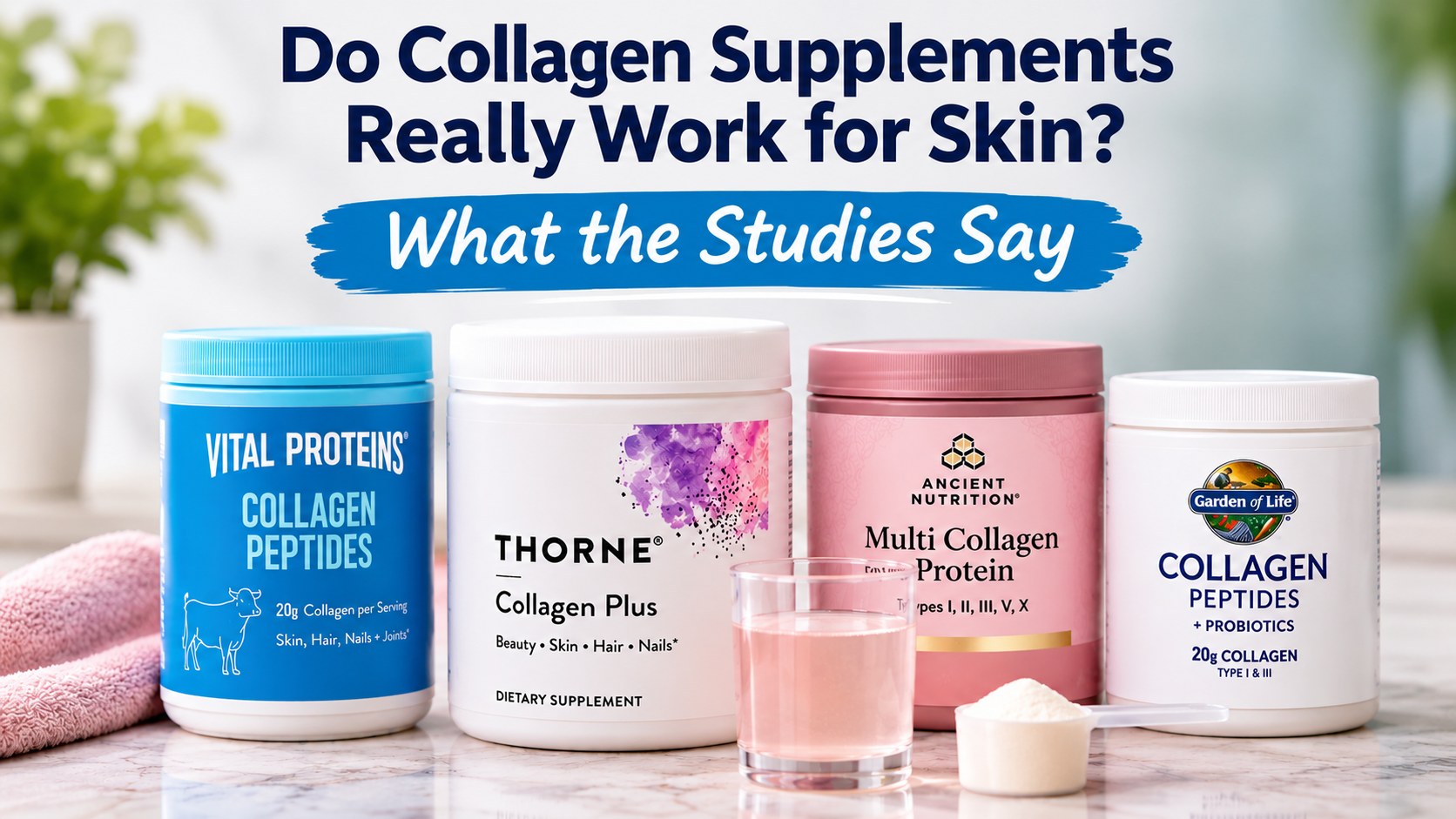
Do Collagen Supplements Really Work for Skin? It Depends on Who Paid for the Study
A 2025 analysis found collagen only seemed to help skin in company-funded studies. Here’s what it found, what the industry says, and what I take away from it.

Some links in this post are affiliate links. I may earn a small commission at no extra cost to you.
On this page
Why I Looked Into This
Collagen powders and gummies are one of the most popular supplements out there, so I wanted to see what the research actually shows. A 2025 analysis looked at the same studies a different way, sorting them by who paid for them, and the picture got a lot more complicated.
When all 23 studies were pooled together, collagen looked like it helped with hydration, elasticity and wrinkles. But in the studies that weren’t funded by companies, and in the highest-quality studies, there was no clear benefit. The collagen industry disagrees with how the studies were sorted. Here’s what both sides say.
What the 2025 Study Found
The study, published in the American Journal of Medicine, combined 23 randomized controlled trials with 1,474 people. Looking at all of them together, collagen supplements improved skin hydration, elasticity and wrinkles. That’s the part brands love to quote.
But the researchers didn’t stop there. When they split the studies by funding, the ones paid for by companies showed benefits, and the ones without company funding showed no effect. They also sorted by quality, and the higher-quality studies didn’t show a significant benefit either. Their conclusion was that there’s currently no clinical evidence to support taking collagen to prevent or treat skin aging.
The Other Side
To be fair, the collagen industry pushed back hard. A collagen trade group argued that some studies were put in the wrong funding group and that a few doses were reported incorrectly. Other critics point out that almost all collagen research gets some kind of company support, so finding truly independent studies is hard.
There’s also an earlier 2023 analysis of 26 studies that found improvements in hydration and elasticity. So this isn’t a case where everyone agrees collagen does nothing. It’s more that the strongest evidence is also the evidence with the most money behind it.
What I Take Away From This
This doesn’t mean you need to throw out your collagen if you like it. It’s a protein, and it’s generally considered safe for most people. But I’d stop expecting it to change your skin on its own, and I wouldn’t pay a premium for a fancy brand because of its skin claims.
If skin aging is your main goal, the things with stronger evidence are still the basics: daily sunscreen, a retinoid, and treatments like microneedling or LED if those fit your budget. And if you do take collagen, look for a brand that does third-party testing, since supplements aren’t checked by the FDA before they’re sold.
Final Thoughts
This is one of those topics where how you slice the data changes the answer. I’d love to see a large, truly independent study settle it. Until then, I’d treat collagen as a nice extra, not a skin treatment.
Do you take collagen? Have you noticed a difference? Tell me in the comments!