📌 Quick Overview
In a 2024 study, mice bred to go gray early had fewer gray hairs after 16 weeks of daily luteolin, whether it was applied to their skin or given by mouth. Two closely related plant compounds were tested the same way and didn’t make a difference, so the effect seemed specific to luteolin. This was only done in mice, at a dose far higher than a supplement capsule, and there’s no human study yet showing luteolin works on gray hair. But it has sparked more interest in this compound, and more people are now taking luteolin as a supplement, hoping some of those benefits carry over to humans.
Luteolin isn’t a new compound. You’ve probably eaten it without knowing it, since it’s found in foods like celery, peppers, thyme, and oregano. It’s also sold as a supplement, and it started getting more attention after a 2024 study showed it helped prevent gray hair in mice.[1]
What caught my attention is that researchers tested three similar plant compounds on the skin, and luteolin was the only one that made a real difference.[1] That tells you something specific is going on with luteolin, not just a general antioxidant effect.
Gray hair isn’t the only reason people are interested in it, though. Luteolin has been studied for years for its effects on inflammation and on the kind of cell damage that builds up as you age. Most of that research has been done in labs and animals, and the human studies usually combine luteolin with other ingredients. I’ll walk you through all of it below, including what the research actually shows and where it falls short.
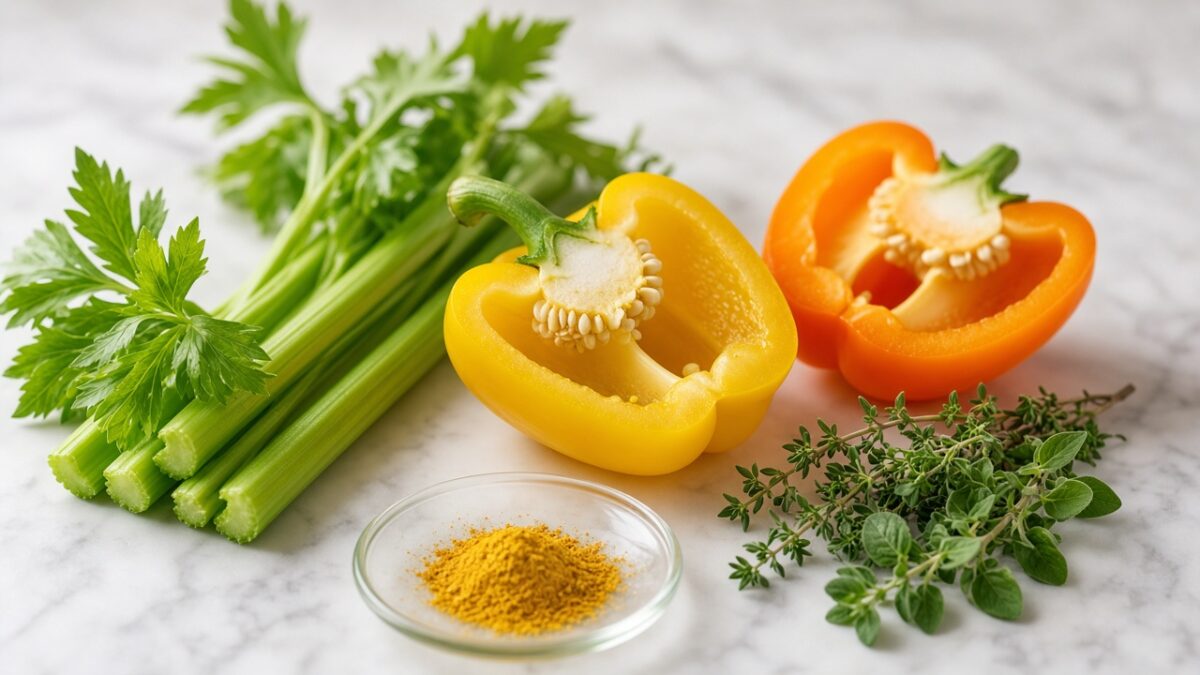
Luteolin is a compound found in plants like celery, thyme, and oregano.
What Is Luteolin?
Luteolin is a flavonoid, which is a group of plant compounds that act as antioxidants. Flavonoids are found in a lot of fruits, vegetables, and herbs, and they’re part of what gives plants their color and helps protect them from stress and damage.
The amount you get from food is fairly small. Supplements are much more concentrated, and they’re usually made from an extract of Sophora japonica flower buds, a plant that’s naturally high in luteolin. The extract is standardized, which just means each capsule contains a consistent, measured amount, so you know exactly how many milligrams you’re taking.
Realistic Expectations
Most of the research on luteolin has been done in cells and animals. There are some human studies, but not many, and most of them test luteolin mixed with other ingredients rather than on its own. So while the early findings are interesting, there’s still a lot we don’t know about what it does in people.
That’s true for a lot of supplements. The supplement industry is still the wild west in many ways, and plenty of products are sold with very little human research behind them. After looking into so many supplements over the years, I’ve noticed that the boldest marketing claims are often based on mouse or lab studies, not on real results in people. It’s worth checking where a claim actually comes from before you buy into it.
The Gray Hair Study: What the Researchers Actually Did
The study was published in 2024 in the journal Antioxidants, by a team of researchers in Japan (Iida et al.).[1]
The first thing to know is that these weren’t ordinary lab mice. The researchers used a special strain that was genetically engineered to go gray much faster than normal mice as they age. That makes it easier to see whether a treatment is actually slowing down graying, since you don’t have to wait years for it to happen.
The researchers who developed this strain believe the way these mice go gray is similar in some ways to how people go gray, especially when it comes to the stem cells that give hair its color. That’s part of why the results are interesting. But it’s still a mouse study, and similar doesn’t mean the same.
Study Size And Timing
For the main anti-graying experiments, they used small groups of about five mice per treatment arm (luteolin vs control solvent). The key treatment window ran from about 20 weeks of age to 36 weeks of age, which is roughly 16 weeks of daily treatment. They also ran shorter hair-cycle checks in younger mice (around 7 to 13 weeks of age).[1]
How Luteolin Was Given
The researchers tested luteolin two different ways, and each group was treated daily for about 16 weeks.
On the skin: A 1% luteolin liquid (dissolved in alcohol) was applied to a shaved patch on each mouse’s back every day. They shaved the area on a regular schedule so they could watch the hair grow back and measure how much of it came in gray.
By mouth: The other group got luteolin by mouth at a dose of 500 mg per kilogram of body weight per day. That’s a huge dose. Using the standard conversion researchers use to compare mouse and human doses, it would work out to roughly 2,800 mg a day for a 150-pound person. Most luteolin supplements contain somewhere around 50 to 100 mg per capsule, so taking one capsule a day is nowhere close to what these mice got.[1]
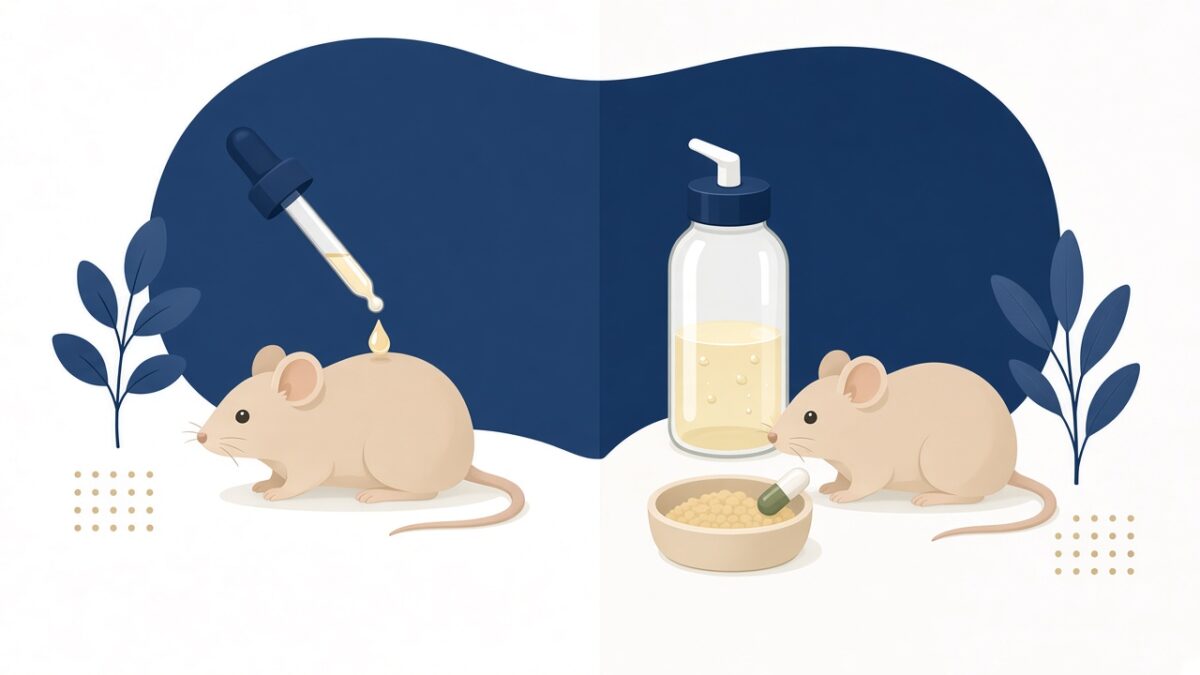
What They Compared
They also tested topical hesperetin and topical diosmetin at 1% in the same kind of setup. Those two related flavonoids did not significantly change gray hair percentages the way luteolin did.[1]
What They Found
The mice treated with luteolin ended up with fewer gray hairs than the mice that didn’t get it. This happened in both groups, whether the luteolin was applied to the skin or given by mouth.[1]
The researchers also looked at the hair follicles under a microscope to figure out why. Your hair gets its color from pigment cells, and those pigment cells come from a small supply of stem cells living in the hair follicle. As you age, that supply runs low, and the new hair grows in without color.
In the luteolin mice, more of those color-producing stem cells stuck around. The surrounding cells in the follicle also stayed healthier and aged more slowly, and they kept sending the chemical signals that tell the pigment stem cells to stay active. In other words, luteolin seemed to help protect the whole system that keeps hair colored.[1]
The two similar plant compounds tested on the skin didn’t have this effect. That’s part of what makes the study interesting, because it suggests luteolin is doing something specific, not just acting as a general antioxidant.
What the Mice Looked Like: Luteolin on the Skin
These images come straight from the study.[1] The photo shows the mice after about 16 weeks of treatment. The two mice on the left didn’t get luteolin (the control group), and the two on the right did. The study didn’t include a before photo of these same mice, so this is only the after.
The chart shows how the percentage of gray hair changed over the 16 weeks. One thing to know before you look at it: the chart is upside-down from what you’d expect, so 0% gray is at the top and more gray is lower down.
Both groups started at about 20% gray. By 16 weeks, the mice without luteolin had gone to roughly 90% gray, while the luteolin mice stayed close to where they started.
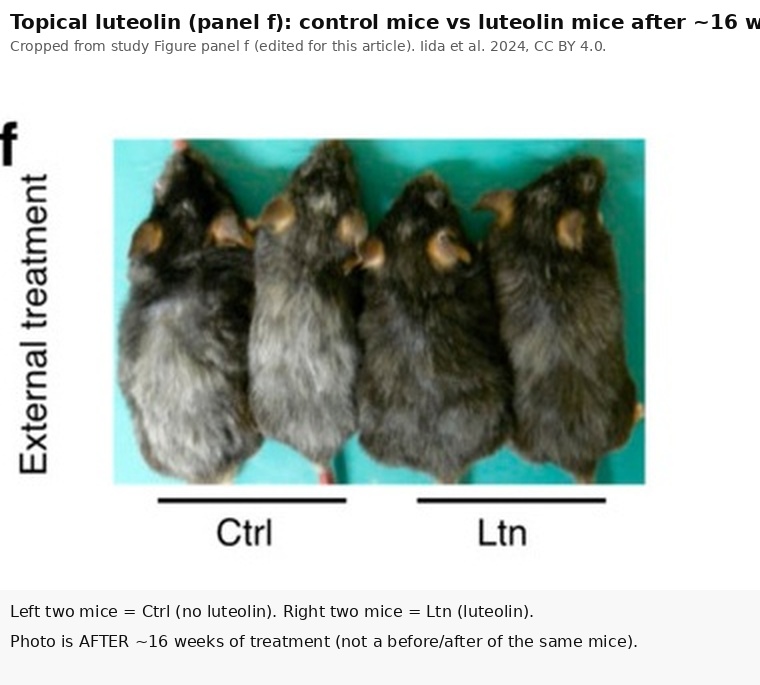
After about 16 weeks. No luteolin on the left, luteolin on the right.
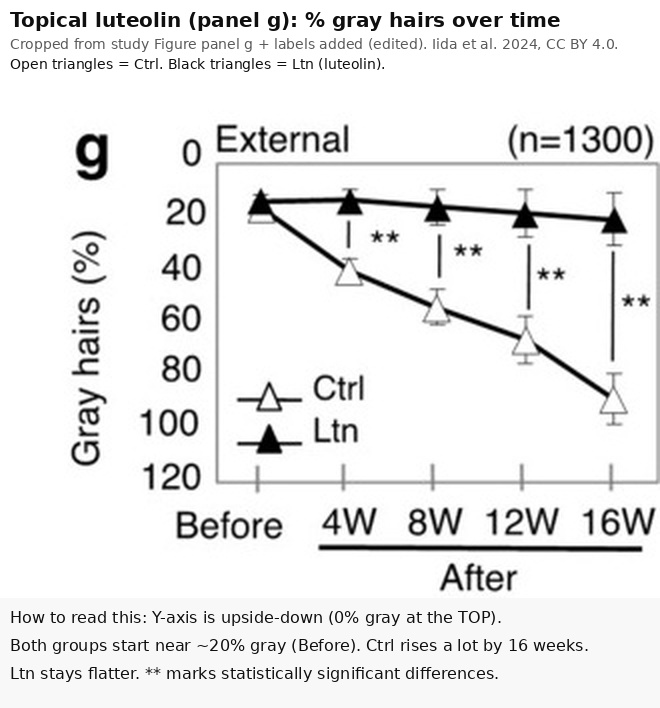
Percentage of gray hair over 16 weeks with luteolin applied to the skin. 0% gray is at the top.
What the Mice Looked Like: Luteolin by Mouth
The same setup applies here. In the photo, the two mice on the left didn’t get luteolin, and the two on the right did. The chart is upside-down in the same way.
The oral group started at about 20 to 25% gray. By 16 weeks, the mice without luteolin were at roughly 60% gray, while the luteolin mice stayed much closer to where they started. The difference is smaller than in the skin group, but it’s still clear.
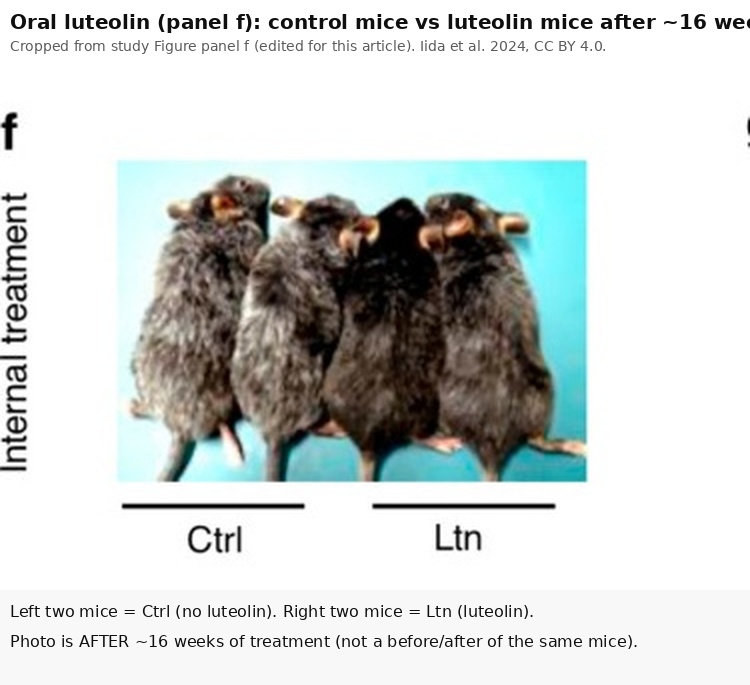
After about 16 weeks. No luteolin on the left, luteolin by mouth on the right.
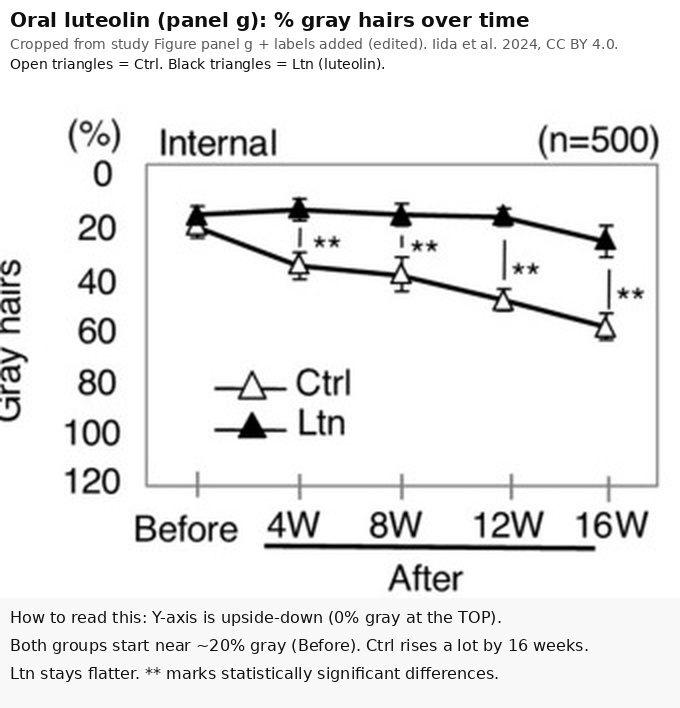
Percentage of gray hair over 16 weeks with luteolin taken by mouth. 0% gray is at the top.
What This Study Doesn’t Prove
This study was done in mice, not people. So far, there’s no published human study showing that luteolin prevents or reverses gray hair. I looked for one testing luteolin on its own and didn’t find any.
It’s also worth knowing that the luteolin used on the mice’s skin was mixed in a lab. That’s not the same as a scalp serum or hair product you’d buy at the store, and none of those have been proven to work on gray hair in people either.
Who Funded the Study
Whenever you look into a study, it’s a good idea to check who paid for it. This one was funded partly by Japanese government research grants and partly by Hoyu, a Japanese hair-care company best known for hair dye. One of the authors works for Hoyu and owns shares in the company. Another author created the mouse strain used in the study and has received fees from Hoyu, including for the rights to the patent.[1]
That doesn’t mean the results are wrong. But when a hair company helps fund a study on gray hair, it makes sense to wait for independent research before getting too excited.
Luteolin and Inflammation: What the Research Shows
Gray hair aside, luteolin is mostly studied for its effects on inflammation and oxidative stress. Oxidative stress is a type of cell damage caused by unstable molecules called free radicals, and it builds up with things like aging, sun exposure, and chronic inflammation.
In lab and animal studies, luteolin has been shown to calm down some of the body’s inflammation signals. One of the main ones is NF-κB, which works kind of like a master switch that turns on inflammation in the body. Luteolin also seems to help cells handle free radicals better.[7][8]
There’s a lot of this kind of research, and the results have been fairly consistent. But it’s mostly been done in cells and animals, so it doesn’t tell us how well luteolin works for inflammation in people.
What We Know From Human Studies So Far
Human evidence is more limited. Some trials use luteolin alone, but many human studies use combination products. A clear example is PEA plus luteolin (often about 700 mg PEA with 70 mg luteolin, sometimes labeled as a ~770 mg co-ultramicronized PEA-LUT product) studied for post-COVID smell recovery alongside olfactory training.[4] Those results may support an anti-inflammatory or neuroinflammation angle for that combo. They do not let you honestly credit luteolin by itself at a standard supplement dose.
Other human work also uses mixed formulas – for example, an open-label pilot of a luteolin-containing dietary formulation in children with autism spectrum disorders,[5] and a related report linking behavioral improvement with lower serum IL-6 and TNF in that same research line.[6] Again: combination products, not a clean test of a single-ingredient luteolin capsule.
Luteolin for Skin Health & UV Damage
If you’re into skincare, this is one of the more interesting areas of luteolin research. Most of it focuses on UVB, the type of sun rays that cause sunburn and contribute to skin aging.
In studies using human skin cells, luteolin helped reduce some of the damage and inflammation caused by UVB exposure.[2] In a small study with human volunteers, a plant extract rich in luteolin was applied to the skin before UVB exposure, and it reduced redness afterward. People also tolerated it well, without irritation.[3]
It’s worth keeping in mind that these studies used luteolin on the skin, not in a capsule. Taking it as a supplement isn’t the same thing, and there’s no clear evidence yet that a capsule would protect your skin the same way. It’s also not a replacement for sunscreen.
My Experience: Hashimoto’s, Inflammation, And White Hairs
I’m 44, and I only have a handful of gray or white hairs, probably fewer than ten. I know some people start going gray much earlier than that, so I feel lucky. I’m not taking luteolin because I expect it to prevent gray hair. But, I am hoping it helps!
What really got my attention was the inflammation research.
Years ago, when my Hashimoto’s wasn’t under control, I started noticing pure white hairs showing up, mostly in my eyebrows and sometimes on my head. I was told this was auto-immune, and inflammation-related.
So when I came across a supplement that had both an interesting gray hair study and years of research on inflammation, I wanted to learn more about it and give it a try.
This post may contain affiliate links & I will earn a small commission if you purchase through them.
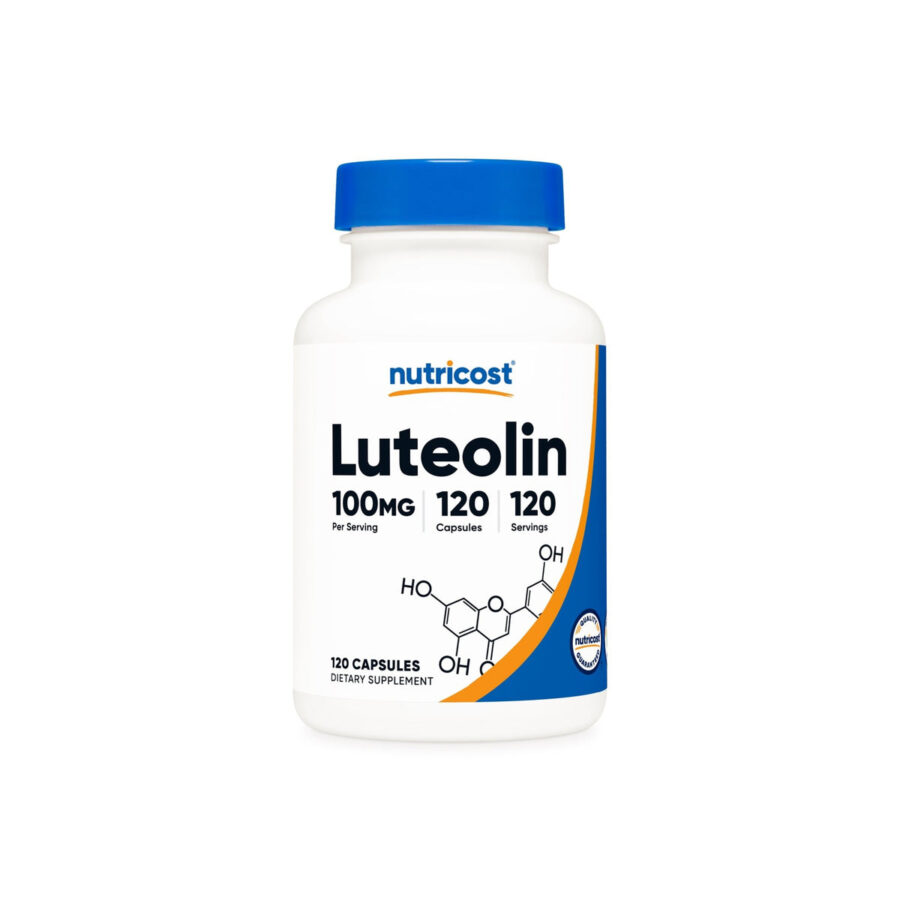
The Luteolin Supplement I Use
I’m currently taking Nutricost Luteolin. Each capsule contains 100 mg of luteolin, and the bottle has 120 capsules. You can check it out here.
Final Thoughts
The gray hair study is interesting, especially since luteolin worked when two similar plant compounds didn’t. But it was a small study done in mice, at a dose much higher than any supplement, and it was partly funded by a hair-care company. Until there’s research in people, there’s no way to know if luteolin will do anything for your gray hair. But, I’m still curious about it and I’m going to keep taking it for now.
For me, the inflammation and skin research is what made it worth trying, especially with Hashimoto’s in my history. I’m taking it as something that’s been well researched in the lab and looks promising, not as a miracle cure.
This post is based on my own research and experience, and it isn’t medical advice.
Have you tried luteolin, or noticed any changes in your gray hair from a supplement? I’d love to hear about it in the comments.
Sources
- Iida M, Kagawa T, Yajima I, et al. Anti-Graying Effects of External and Internal Treatments with Luteolin on Hair in Model Mice. Antioxidants. 2024;13(12):1549.
DOI: 10.3390/antiox13121549.
Full text: PMC11673595.
(MEXT grants; partial Hoyu Co. support; author conflicts disclosed.)
↩ - Wölfle U, Esser PR, Simon-Haarhaus B, et al. UVB-induced DNA damage, generation of reactive oxygen species, and inflammation are effectively attenuated by the flavonoid luteolin in vitro and in vivo. Free Radic Biol Med. 2011;50(9):1081–1093.
PMID: 21281711.
↩ - Casetti F, Jung W, Wölfle U, et al. Topical application of solubilized Reseda luteola extract reduces ultraviolet B-induced inflammation in vivo. J Photochem Photobiol B. 2009;96(3):260–265.
PMID: 19656689.
↩ - Di Stadio A, D’Ascanio L, Vaira LA, Cantone E, De Luca P, et al. Ultramicronized palmitoylethanolamide and luteolin supplement combined with olfactory training to treat post-COVID-19 olfactory impairment: a multi-center double-blinded randomized placebo-controlled clinical trial. Curr Neuropharmacol. 2022;20(10):2001–2012.
PubMed: 35450527
(PEA-LUT combination product.)
↩ - Taliou A, Zintzaras E, Lykouras L, Francis K. An open-label pilot study of a formulation containing the anti-inflammatory flavonoid luteolin and its effects on behavior in children with autism spectrum disorders. Clin Ther. 2013;35(5):592–602.
PMID: 23688534
(combination product.)
↩ - Tsilioni I, Taliou A, Francis K, Theoharides TC. Children with autism spectrum disorders, who improved with a luteolin-containing dietary formulation, show reduced serum levels of TNF and IL-6. Transl Psychiatry. 2015;5:e647.
DOI: 10.1038/tp.2015.142.
Full text: PMC5545641.
↩ - Muruganathan N, Dhanapal AR, Baskar V, et al. Recent updates on source, biosynthesis, and therapeutic potential of natural flavonoid luteolin: a review. Metabolites. 2022;12(11):1145.
PMC: PMC9696498
(mechanisms largely preclinical.)
↩ - Huang L, Kim MY, Cho JY. Immunopharmacological activities of luteolin in chronic diseases. Int J Mol Sci. 2023;24(3):2136.
PMC: PMC9917216
(mechanisms largely preclinical.)
↩