📌 Quick Overview
If you get your prescriptions mailed to you from Canada or any other country, you may not be able to after October 22, 2026. U.S. Customs is changing how these packages are handled, and pharmacies expect most of them to be stopped at the border. Canada gets the most attention because it’s where most Americans order from, but the rule covers mail from every country. Nobody knows yet exactly how strict it will be. Supplements from overseas aren’t banned, but some packages may be delayed or cost more to ship.
Why This Matters If You Order Health Products From Overseas
Most people won’t hear about this until a package doesn’t show up. If you buy any of these from another country, it’s worth reading:
- Prescription medications from Canadian or other international pharmacies (the biggest impact)
- Pet medications from a foreign pharmacy
- Supplements from overseas sellers (not banned, but possible delays or extra fees)
About 4 million Americans import medications for personal use each year, according to surveys cited by KFF Health News. For many of them, it’s the only way they can afford brand-name drugs like blood thinners, diabetes medications, and inhalers.
What the Government Actually Said, and Who’s Behind It
The Rule Itself: On June 24, 2026, U.S. Customs and Border Protection (CBP), part of the Department of Homeland Security, published a rule about packages that come in through international mail. It never mentions prescriptions from Canada. It’s mostly about taxes and paperwork for small packages.
The “De Minimis” Exemption: For years, packages worth $800 or less could come into the U.S. without formal customs paperwork or import taxes. That’s called the de minimis exemption, which basically means “too small to bother with.” CBP said over 1.36 billion packages came in this way in 2024, almost ten times more than in 2015.
Who Ended It: President Trump suspended the exemption by executive order in July 2025, and it’s been suspended since August 2025. Separately, Congress passed a law in July 2025 that ends it for good on July 1, 2027. The June 2026 rule puts that change into CBP’s official regulations and sets up a new system for mail packages.
The Government’s Stated Reasons: CBP said small packages were being used to sneak in fentanyl and other illegal drugs, counterfeit goods, and products that skip import taxes. There were too many packages with too little information to check them properly.
Why October 22 Matters for Prescriptions
Most of the rule is already in effect. On October 22, one specific part kicks in: any mail package containing something the FDA regulates, like prescription drugs, has to go through “formal entry.” That’s the full customs process used by commercial importers. It requires a licensed customs broker, a financial bond, and detailed electronic filings, and a pharmacy in Canada or anywhere else mailing you a 90-day refill isn’t set up to do that for every small package.
What the FDA’s Role Is: Importing most prescription drugs for personal use has technically always been illegal. For about 25 years, though, the FDA has used a personal importation policy that generally lets up to a three-month supply through. The new system gives customs and the FDA far more visibility into each package, and it removes the simple route these shipments were using.
Why This Might Seem Contradictory: In 2020, the Trump administration approved a plan to import prescription drugs from Canada to help lower prices, so some people are wondering why it’s now getting harder. The two policies work differently, though. The 2020 plan let states like Florida buy drugs in bulk from Canadian wholesalers through an FDA-approved program, and it didn’t cover individuals ordering by mail.
The new rule doesn’t target Canada or prescriptions by name. It’s part of a much broader effort to tighten control over small packages, and personal prescriptions are caught up in it. Either way, the effect on patients is the same.
CBP also issued the rule without the usual public comment period beforehand, saying the timing was tied to ongoing trade and security negotiations. It accepted comments afterward, which is part of why many people are only hearing about it now.
Why Pharmacies Expect Prescription Shipments to Stop
The People’s Pharmacy spoke with Lucia Mueller of PharmacyChecker. She said the companies that process these packages have concluded they can’t meet the new requirements for personal prescription orders. Her prediction is that few, if any, of those shipments will keep making it into the U.S. through the mail. The Canadian International Pharmacy Association (CIPA) sent out a similar warning.
It’s Not Just Canada: The rule covers mail packages from every country, so the same problem applies to pharmacies in the UK, India, Australia, and anywhere else that mails prescriptions to the U.S. Canadian pharmacies are just the ones sounding the alarm, because they serve the most American customers.
To be fair, no FDA or CBP announcement actually says “personal prescriptions are banned.” But, when the companies handling the packages say they can’t process them, the result is pretty much the same for the people waiting on their medication.
What About Supplements From Overseas?
Supplements aren’t banned, and you can still legally buy them from other countries. What’s changing is the paperwork. Packages sent by regular international mail now need more detailed customs filings, including a Prior Notice to the FDA, which tells them a supplement shipment is on the way.
Most established sellers will likely adapt, but you may see higher shipping costs, slower delivery, or a package held at customs if a seller doesn’t file correctly. Packages sent by express couriers like FedEx, UPS, or DHL already go through a different process, so they’re less likely to be affected.
If you buy supplements from an overseas brand, check their shipping page or email them before your next order to see how they’re handling the change.
Why I’m Watching This So Closely

I’m affected by this too, and it’s for my cat Kipper. He’s 14 and has asthma. In March 2026, his chest x-rays showed thickening in his larger airways and a partially collapsed lung.
The medical term is atelectasis, which means part of the lung has deflated and isn’t filling with air the way it should. In his case, it was the right middle lobe, and the vet thought asthma was the likely cause.
After that, I spent time reading veterinary studies to find the best possible treatment for his lungs.
What I found is that inhaled steroids are one of the main long-term treatments for asthma in cats, and fluticasone propionate is one of the most studied. It’s the same inhaler people use for asthma.
This post may contain affiliate links & I will earn a small commission if you purchase through them.
In one study on cats with allergic airway inflammation, even the lowest dose tested (44 mcg twice a day) cut the inflammatory cells in their airways by about 74%. Because it’s breathed straight into the lungs, very little gets absorbed into the rest of the body, which makes it gentler for long-term use than oral steroids like prednisolone.
Cats can’t use an inhaler on their own, so it’s given through a spacer. That’s a clear plastic tube with the inhaler on one end and a small mask that fits over the cat’s nose and mouth on the other. AeroKat is the best-known brand. I give Kipper his inhaler once a day, and it took a lot of training to get him comfortable with the spacer and mask.
On September 27, his new chest x-rays were all clear, with no signs of asthma or inflammation. I believe this is why his lungs are all clear now. It’s incredible.
The Price Difference
Brand-name Flovent HFA was discontinued in the U.S. in 2024, so only the authorized generic is sold here now. GoodRx lists the average U.S. retail price for fluticasone HFA at around $276, and even with a coupon, it’s usually $160 or more.
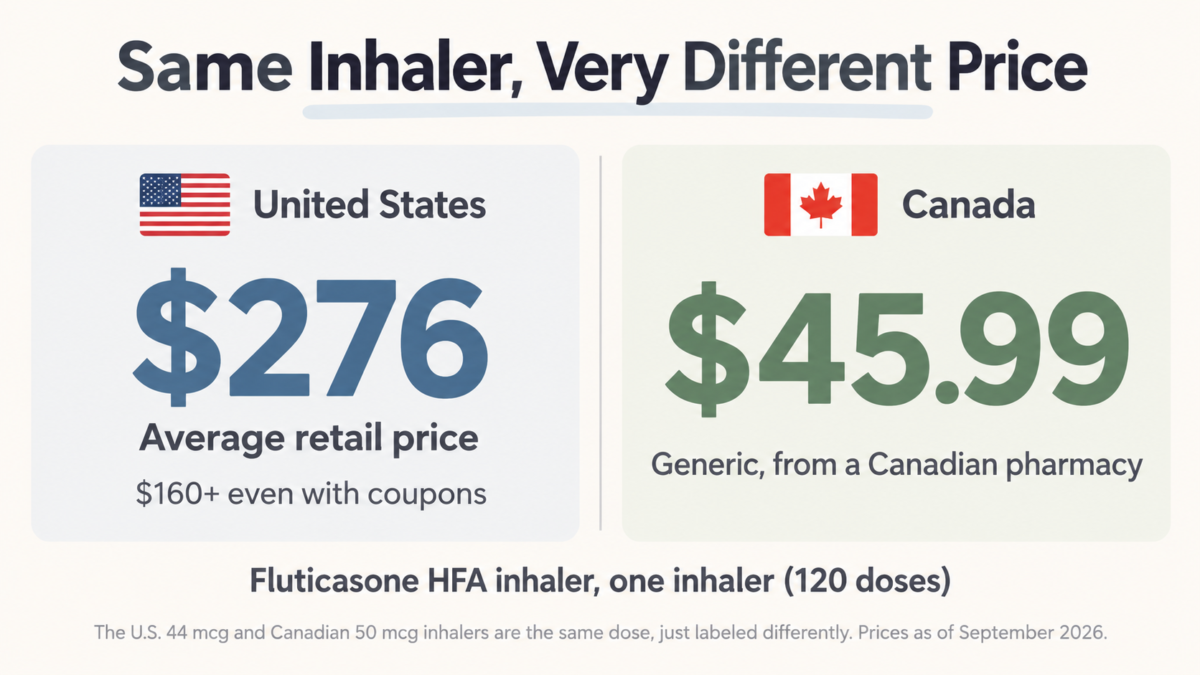
I order Kipper’s inhaler from Cloud Pharmacy in Canada with a prescription. They currently list the generic 50 mcg inhaler (made by Apotex) at $45.99, and the GSK brand version at $89.99.
Canada labels this strength as 50 mcg and the U.S. labels it as 44 mcg. It’s the same dose, just measured at a different point in the inhaler.
My pharmacy emailed customers saying that anyone who needs a refill should order before October 10, so it has time to ship before the 22nd.
What You Can Do
The Campaign for Personal Prescription Importation (CPPI) is a nonprofit patient group fighting the prescription side of this. They’ve set up a pre-written letter you can send to your members of Congress in a few minutes, and joining is free.
A few practical steps:
- If your pharmacy gives an order deadline, take it seriously.
- Look up your medication’s U.S. price on GoodRx or SingleCare, so you know your backup cost.
- If you’re on a medication you can’t safely stop, like a blood thinner, talk to your doctor now. Don’t wait until a shipment doesn’t arrive.
- Before your next overseas supplement order, check how the seller ships to the U.S. and whether they’ve updated for the new customs rules.
- Be careful with new websites promising even cheaper prices. The People’s Pharmacy warned that scammers selling counterfeit medications could take advantage of this.
Final Thoughts
I think this rule was aimed at cheap overseas goods and illegal drugs, and prescription access got caught in the middle. For me, it’s my cat’s inhaler. For other people, it’s a blood thinner or a diabetes medication they can’t afford at U.S. prices. If this affects you, the CPPI letter only takes a few minutes, and I think it’s worth sending.
Do you order medications or supplements from outside the U.S.? What are you planning to do if your packages stop coming after October 22?
Disclaimer: This post is for informational purposes only and isn’t medical, veterinary, or legal advice. Talk to your doctor or vet before making any changes to your medications or your pet’s.