
If you’ve ever turned your head and suddenly felt the room spin, there’s a chance it was something called BPPV. The symptoms can hit you violently and leave you incredibly ill all of a sudden.
This happened to me for the second time recently and it was one of the worst experiences of my life. I’m sharing about it here in case you’re ever in this situation, you’ll know about BPPV and what to do if you suspect it. Thankfully, BPPV is a benign inner-ear issue and is treatable at home, but you have to be really careful to figure out what type you’re dealing with, so you can choose the correct maneuver.
This isn’t medical advice – just my experience and the steps that helped me understand what was happening.
What Is BPPV?
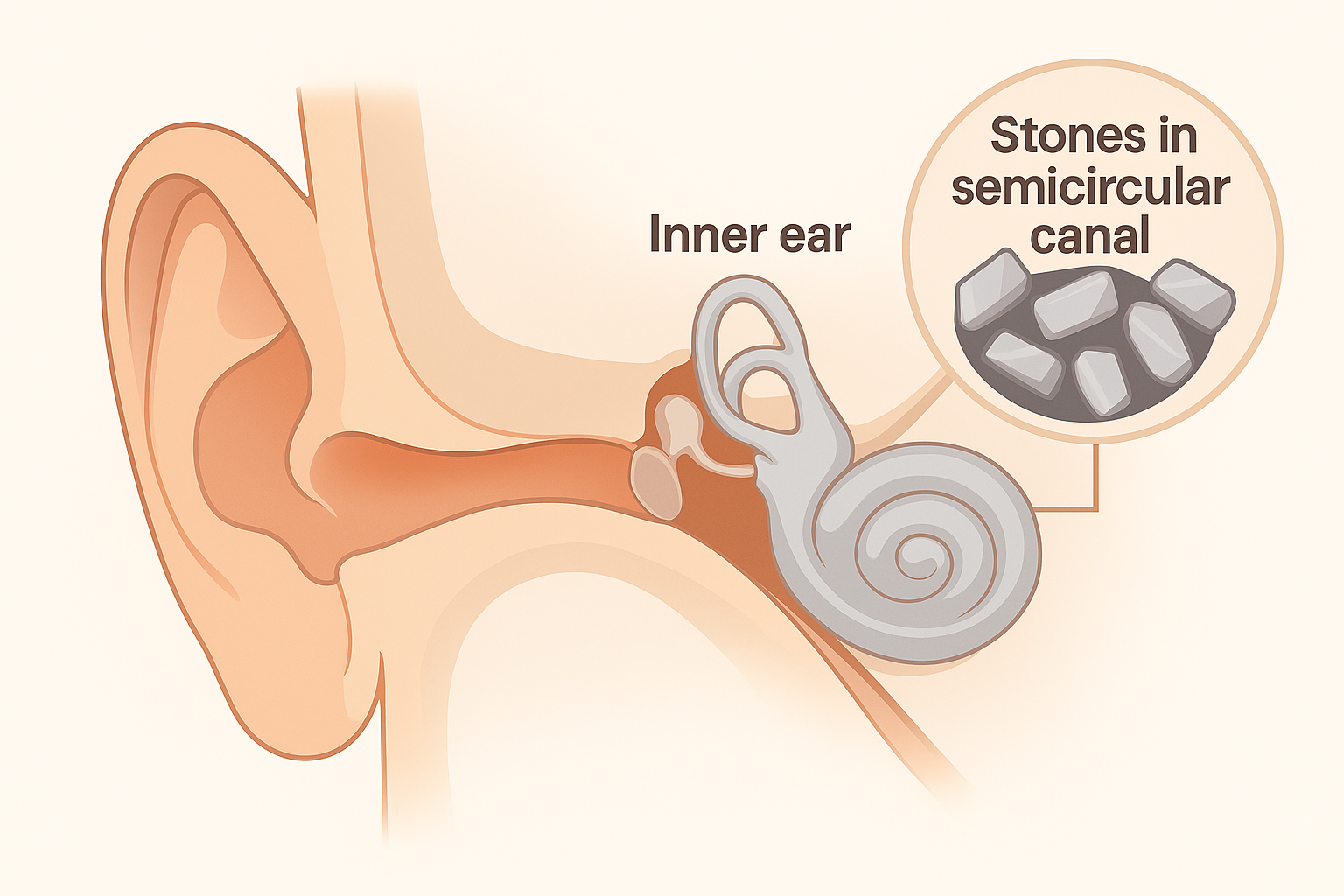
BPPV stands for benign paroxysmal positional vertigo. It’s a type of vertigo caused by tiny crystals in the inner ear moving into the wrong canal. When that happens, certain movements can make the room feel like it’s spinning, even though your body isn’t moving at all. There are two main types of BPPV.
Posterior Canal BPPV
This is the most common type. The loose crystals move into the posterior canal of the inner ear. People often notice brief, intense spinning when they lie back, look up, or roll over in bed.
Horizontal Canal BPPV
In this type, the crystals move into the horizontal canal instead. The spinning can feel stronger and is usually triggered when you turn your head side to side or roll in bed.
Why This Matters
Even though the symptoms can feel similar, these two types of BPPV are not treated the same way. It’s important to identify which type you’re dealing with before attempting any of the recommended maneuvers. The very first step is figuring out which ear is most affected.
Before You Try Any Maneuvers to Fix Your BPPV
Some people choose to treat BPPV at home. There’s a lot of excellent guidance available online through medical websites and physical therapy videos that walk you through the process step-by-step. If you feel uncomfortable doing this yourself, you can always see a professional. Many physical therapists are trained in vestibular rehabilitation and can diagnose and treat BPPV in the clinic.
But if you live in a rural area, can’t get in quickly, or you’re feeling so sick from the vertigo that you want relief as soon as possible, it is possible to work through this at home with the right information.
Determine the Ear Involved
The very first step is to figure out which ear, or which side is involved. You might notice symptoms on both sides, but most people find that one side triggers the dizziness more strongly. That’s your starting point. Once you know which ear seems worse, you can move on to the positional tests that help determine which canal is involved.
Dix-Hallpike Test – What It’s Actually Used For
Before trying any maneuver, most professionals recommend doing a positional test first. The most common one is the Dix-Hallpike test, which checks for posterior canal BPPV. This is the most frequent type of BPPV, and the Dix-Hallpike is designed specifically to bring out the eye movements linked to it.
Someone needs to watch your eyes during the test, because the direction of your eye movements (nystagmus) gives important clues. If you don’t have anyone who can watch, you can record your eyes on your phone. I recommend watching the Gordon Physical Therapy video for a clear demonstration of how the Dix-Hallpike is done and what it’s meant to assess.
What the Dix-Hallpike Can & Can’t Tell You
The Dix-Hallpike test helps determine whether the posterior canal is involved. Here’s what you may see: Up-beating with a slight twist (torsion) – This usually points to posterior canal BPPV.
If your eye movements do not match this pattern, or if the result feels unclear, it doesn’t automatically mean you don’t have BPPV – it simply means the horizontal canal may need to be tested separately.
Supine Roll Test for Horizontal Canal BPPV
Horizontal canal BPPV uses a different positional test called the supine roll test, because its eye movement pattern is different (pure side-to-side beating rather than twisting).
The eye movement patterns can be hard to describe in writing, so watching a video demonstration is extremely helpful.
What to Do Once You Know the Canal Type
Once you determine which ear and which canal are affected, you can choose the appropriate treatment maneuver. This part is important, because the maneuvers are not interchangeable. The wrong one can make the symptoms extraordinarily worse – which is exactly what happened to me (See video for my in-depth experience).
Here is a simple overview:
If You Have Posterior Canal BPPV
Most people will use the Epley maneuver. Make sure you follow the correct version depending on which ear is affected (right ear vs. left ear).
If You Have Horizontal Canal BPPV
Many vestibular therapists recommend the Gufoni maneuver as a first-line option. There are other horizontal maneuvers available, but the Gufoni is well-regarded and often successful for this type.
The videos from vestibular-trained physical therapists walk you through the exact instructions and demonstrate which maneuver goes with which canal. I recommend watching numerous videos by Gordon Physical Therapy or other similar channels to really understand prior to trying any of these tests or treatment maneuvers.
How Fast Your Symptoms May Resolve
Once you perform the correct maneuver, your major symptoms could resolve quite immediately. With saying that, some people do require multiple maneuver attempts in order to get full relief. It will only work if you’re doing the right treatment based on the correct ear and canal. Even though the major symptoms can resolve very quickly, you may experience some lingering minor symptoms for a few weeks afterwards.
My Experience
I recommend watching my short video for an in-depth explanation of what I experienced.
My symptoms started suddenly while turning in bed. Each time I rolled from one side to the other, the room began spinning. It was strong enough that I had to sit up and couldn’t go back to sleep.
I’d had BPPV once before after flying, so the only maneuver I knew was the Epley. I didn’t realize at the time that different types of BPPV require different maneuvers. Because of that, I tried the wrong one, and it made my symptoms significantly worse.
The dizziness intensified immediately, and I felt extremely nauseous.
After that, I realized I needed to figure out which canal was involved. My son helped me with the positional test and watched my eye movements. Based on what he saw, it appeared to be the horizontal canal on the left side.
Once I knew that, I used the Gufoni maneuver, which is one of the recommended treatments for horizontal canal BPPV.
This involved lying on my right side for about a minute, then turning my head down toward the ground.
The dizziness was mild, which usually means the crystals moved out of the sensitive area. After that, the spinning stopped.
Even though the main vertigo resolved, I still had some lingering symptoms over the next several days, such as slight wooziness and feeling cautious with head movement. That gradually improved.
Possible Causes of BPPV
BPPV can happen without any clear reason, but certain situations can make it more likely. In my case, I believe it was a combination of intense shoveling (with a lot of bending, lifting, and head movement) and a major barometric pressure change right before a big snowstorm. Earlier that day my ear felt slightly clogged, and the pressure shift seemed to trigger everything. I also had an episode of BPPV once before after a long airplane flight, which also involved significant pressure changes.
Other possible contributors for people can include:
- head injuries or minor impacts
- dental work (vibration from drilling)
- vigorous exercise with lots of head movement
- sinus or ear congestion
- prolonged lying on one side
- aging, which can make the crystals more prone to shifting
- sometimes no identifiable trigger at all
If you’ve ever experienced this, please share it in the comment section below.